
Start With Acceptance, Not With Cost#
The temptation is obvious. One of these tests costs roughly a third of the others and returns a result in two days. A student comparing a ₹19,000 fee against a ₹6,600 one reaches the sensible conclusion immediately.
And then discovers that the programme they want does not accept it.
Acceptance is the first filter and everything else is second. A cheap test your university will not take is not a saving; it is a wasted fee and, more expensively, wasted weeks. Check the specific programme's accepted tests before you compare anything else in this article.
Once acceptance is settled, the differences are genuinely substantial. Fees range from around ₹6,600 to ₹19,000. Results arrive anywhere between forty-eight hours and around two weeks. Two of the four are scored primarily by machine and two involve human raters in different proportions. The scales are entirely different from each other.
This guide compares all four on the factors that decide the choice in practice.
Background: What Actually Differs Between Them#
Who accepts them. The broadest acceptance sits with IELTS and TOEFL, which are the long-established standards and are recognised essentially everywhere, including for visa and immigration purposes in several countries. PTE Academic is accepted by thousands of institutions and recognised in Australia, the United Kingdom, Canada and the United States. The Duolingo English Test reports acceptance by over six thousand institutions, which is a large number and still not universal.
How they are scored. IELTS uses human examiners for speaking and writing. TOEFL uses a combination. PTE Academic moved to a hybrid model from August 2025 in which AI evaluates all responses instantly while human reviewers monitor for memorised or template-based answers. The Duolingo test is computer-adaptive and machine-scored.
How long they take to come back. This matters far more than students expect when a deadline is close.
And what the scale looks like, which affects how you set a target and how the university reads it.
Two terms worth defining:
Computer-adaptive. A test that adjusts question difficulty based on your previous answers, which allows a shorter test to estimate ability. The Duolingo test works this way.
Score sending. The process of transmitting an official result to an institution. Some tests charge per institution; at least one sends to unlimited institutions at no cost.
The Four Compared#
| IELTS | TOEFL iBT | PTE Academic | Duolingo English Test | |
|---|---|---|---|---|
| Fee in India | ₹19,000, increased from 1 April 2026 | ₹18,000 including GST | ₹18,900 including 18% GST, effective March 2026 | About US $59, roughly ₹6,600. Two tests for about US $100 |
| Score scale | Bands 0 to 9 in half-band steps | Bands 1 to 6 in half-band steps since 21 January 2026, CEFR aligned | 10 to 90 in single-point steps | 10 to 160 |
| Results | Around 3 to 5 days for computer-delivered, longer for paper | Typically within a few days | Typically about 48 hours, stated as 1 to 5 business days | 48 hours, with a 12-hour option for an additional fee of about US $40 |
| Scoring method | Human examiners for speaking and writing | Combination of automated and human scoring | Hybrid since August 2025: AI scores all responses, human reviewers check for memorised or templated answers | Computer-adaptive and machine scored |
| Acceptance | The broadest, including immigration and visa uses in several countries | Equally broad, the long-standing standard in the United States | Accepted by thousands of institutions, recognised in Australia, the UK, Canada and the USA | Reported acceptance at over 6,000 institutions, and growing, but not universal |
| Score sending | Charges may apply beyond an included number | Charges apply beyond an included number | Charges may apply | Unlimited, at no additional cost |
| Where it is taken | Test centre, or computer-delivered | Test centre or home edition | Pearson-authorised test centres | At home, on your own computer |
The cost column is the one that makes people stop reading the rest. A difference of roughly ₹12,000 between the cheapest and the most expensive is real money for most Indian families, and it should carry weight. It should just not carry the first weight.
The results column matters when you are late. A student two weeks from a deadline has effectively one option, and it is the one that returns a result in forty-eight hours.
And the score-sending row is quietly significant. An applicant sending scores to eight universities can find the per-institution charges on a traditional test approach a meaningful fraction of the test fee itself.
Where Each One Is Genuinely The Right Choice#
Take IELTS if acceptance breadth matters most, if you are also applying for a visa route that specifies it, or if you are more comfortable speaking to a human examiner than to a microphone. It remains the safest default and its universality is worth the fee for anyone applying widely.
Take TOEFL if you are applying primarily to the United States, where it has the deepest institutional history, or if your programme's requirement is written in TOEFL terms. Note that the scale changed on 21 January 2026 to a 1 to 6 band system, which is worth understanding before you set a target.
Take PTE Academic if you want a fast, predictable, machine-scored test and your institutions accept it. Its scoring is consistent and its turnaround is quick, and candidates who find the format suits them often score better on it than on the alternatives.
Take the Duolingo English Test if cost or speed is the binding constraint, and only after confirming acceptance at every institution on your list. At roughly a third of the price, with a forty-eight hour turnaround and free unlimited score sending, it is a genuinely different proposition for a student with limited funds or a near deadline.
And take whichever one your programme requires, if it requires one. A surprising number of applicants agonise over a choice that their target programme has already made for them.
The Practical Questions To Settle First#
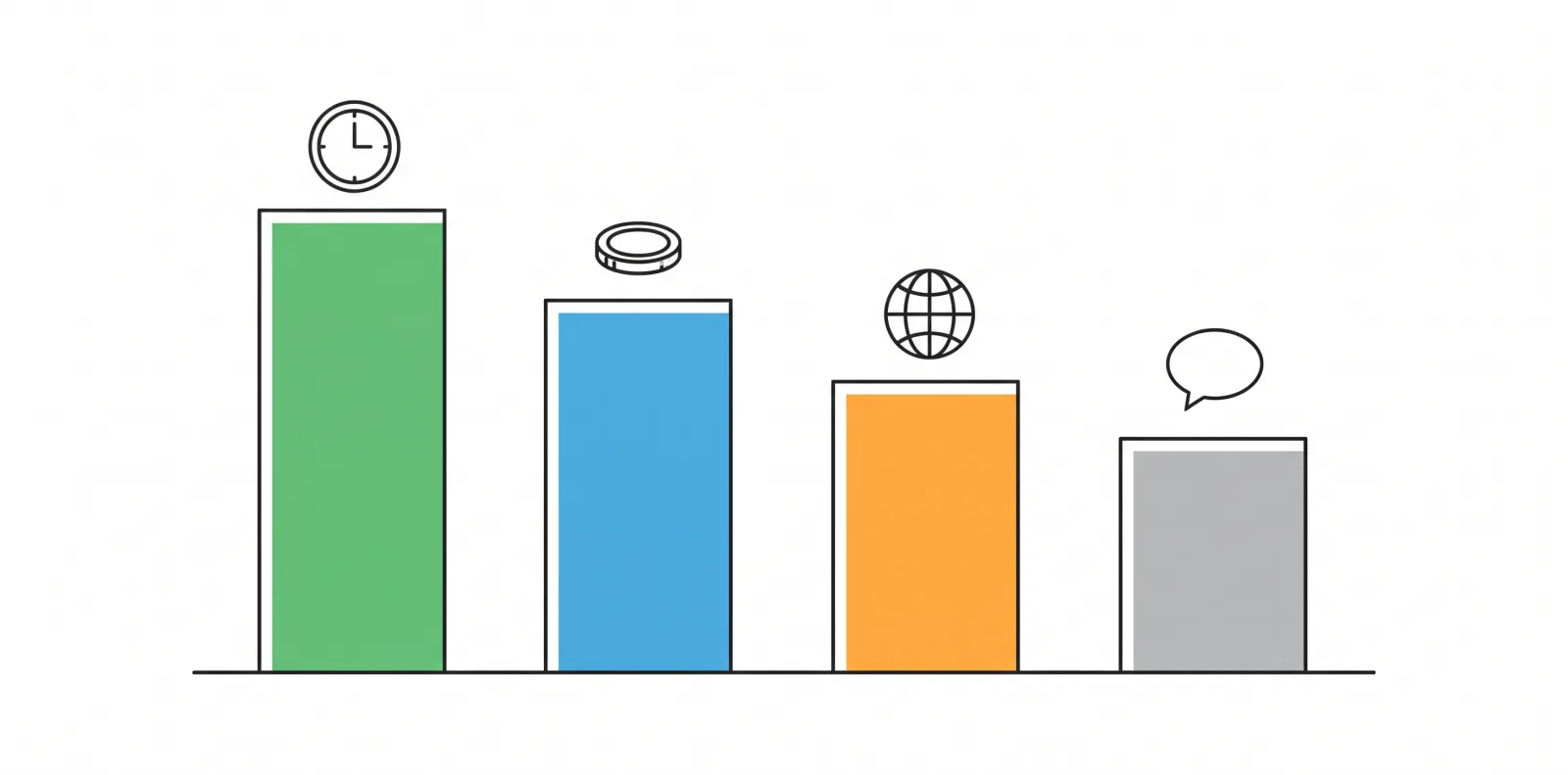
Which tests does each institution on your list accept? Written down, programme by programme. If one institution accepts only IELTS and the rest accept everything, you are taking IELTS, and the comparison is over.
What score do they require, and is there a section minimum? An overall requirement with a separate speaking minimum is a different target, and candidates routinely discover section minimums after testing.
How long until your earliest deadline? Work backwards from it, including result turnaround, score sending time and a possible retake. If the arithmetic is tight, turnaround becomes the deciding factor.
What can you actually afford, including a retake? Budget for the possibility of taking the test twice. A cheaper test taken twice may still cost less than an expensive one taken once, and the option to retake reduces the pressure considerably.
Can you test at home, and do you want to? Home testing removes travel and centre availability constraints and introduces requirements about your room, your equipment and your internet connection. Both matter.
And which format suits you? Take a free practice test of two options before booking. Candidates frequently discover that one format suits them considerably better, and that difference is worth more than any of the factors above.
What Not To Base The Decision On#
Do not choose on perceived difficulty. All four are calibrated to measure the same thing and none is a soft option. Students who pick a test because a forum said it was easier usually find it is not.
Do not choose on which test your friends took. Their university list is not yours and their strengths are not yours.
Do not assume the cheapest test is a shortcut. It is a genuinely legitimate test with genuine acceptance at thousands of institutions. It is also not accepted everywhere, and the failure mode is discovering that after you have taken it.
Do not rely on unofficial equivalence charts to decide. Institutions publish their own conversions and they do not all agree, which means the only conversion that matters is the one your university uses.
And do not book before checking dates. Slot availability at test centres varies considerably by city and by season, and a test you cannot book in time is not an option regardless of its merits.
Cost Against Turnaround, At A Glance#
The two variables that decide most choices, once acceptance is settled, plot against each other cleanly.
Three of the four cluster in the upper left, which is the useful finding. The established tests are all expensive and all reasonably fast, which means cost is not a differentiator among them and turnaround barely is either.
One sits alone in the lower left, at roughly a third of the price with the fastest turnaround. That is the whole argument for the Duolingo test, and the whole reason acceptance has to be checked first.
What the chart cannot show is the axis that actually decides most cases, which is whether your programme accepts the test at all. A test in the ideal corner of this chart is worth nothing if it is not on your university's list, which is why the sequence in this article puts acceptance before everything.
Frequently Asked Questions#
Which English test is cheapest for Indian students?#
The Duolingo English Test, at around US $59 or roughly ₹6,600, compared with ₹18,000 for TOEFL iBT, ₹18,900 for PTE Academic and ₹19,000 for IELTS. It also sends scores to unlimited institutions at no extra cost.
Which test gives results fastest?#
The Duolingo English Test at around 48 hours, with a 12-hour option for an additional fee of about US $40. PTE Academic is also fast, typically around 48 hours and stated as 1 to 5 business days.
Is the Duolingo English Test accepted everywhere?#
No. It reports acceptance at over 6,000 institutions, which is substantial but not universal. Confirm acceptance for every programme on your list before booking, because the failure mode is discovering the gap after testing.
Which test has the broadest acceptance?#
IELTS and TOEFL, which are the long-established standards and are recognised essentially everywhere, including for visa and immigration purposes in several countries.
How is PTE Academic scored?#
Since August 2025 it uses a hybrid model in which AI evaluates all responses instantly while human reviewers monitor for memorised or template-based answers. Results are typically available within about 48 hours.
Did TOEFL change its scoring?#
Yes. On 21 January 2026 the 0 to 120 total was replaced with a 1 to 6 band scale in half-point increments, aligned to CEFR. A comparable 0 to 120 score is also reported during a two-year transition.
Which should I take if I am short of time?#
Whichever your institutions accept that returns results fastest, which in practice usually means the Duolingo English Test or PTE Academic. Work backwards from your deadline including score sending time and the possibility of a retake.
How should I actually decide?#
Settle acceptance first, programme by programme. Then check required scores including any section minimums. Then weigh turnaround against your deadline and cost against your budget. Finally, take a free practice test of your top two and choose the format that suits you.