
The Decision Everyone Treats As A Verdict#
Ask an Indian fifteen-year-old what stream they are taking and watch what happens to their face.
Science is the answer that ends the conversation approvingly. Commerce gets a nod and a follow-up question. Humanities produces a pause, and then something kind and slightly consoling. Vocational rarely comes up at all.
This hierarchy is not based on anything. It is not based on difficulty, since a good humanities course demands analytical writing that most science students would find genuinely hard. It is not based on earnings, since outcomes vary far more within streams than between them. It is not based on intellectual demand, since economics and political science are rigorous disciplines and always have been.
It is based on habit, inherited from a period when engineering and medicine were the only visible routes to secure employment for the Indian middle class.
Meanwhile the actual decision, which is a purely practical question about which degree routes remain available to you, gets very little attention. That question has clear answers. Here they are.
Background: How Class 11 Actually Works#
A few structural facts, because the "streams" are less rigid than people assume.
Streams are a school convention, not a board rule. CBSE specifies a scheme of studies requiring a certain number of subjects including at least one language. Schools then organise available combinations into groups they call science, commerce and humanities, largely for timetabling reasons. The rigidity you encounter is mostly your school's, not the board's.
You take five main subjects plus an optional sixth. One must be a language. The other four come from the subjects your school offers in your chosen combination.
The sixth subject is strategically useful. It can raise your aggregate where universities use a best-of-four or best-of-five calculation, and at Class 10 a skill subject as the sixth carries a substitution provision. Choose it deliberately rather than by default.
Subject combinations decide eligibility, not stream labels. Universities and entrance examinations specify subjects, not streams. Nobody asks whether you were "in science". They ask whether you studied Physics, Chemistry and Mathematics.
That last point is the whole article, really. Think in subjects.
Which Doors Each Combination Keeps Open#
Look at the column pattern rather than the rows and one thing stands out.
Mathematics is the single most consequential subject decision you will make. It is required for engineering, required or strongly preferred for economics at many strong universities, and required for several commerce, statistics, data science and actuarial routes. Dropping it closes more doors than any other single choice, and adding it back afterwards is difficult.
If you are genuinely undecided, taking Mathematics is the option that preserves the most future choices. That is not an argument that everyone should take it. It is an argument that you should drop it only deliberately, knowing what it costs, rather than because it seemed hard in Class 10.
The Four Routes, Described Honestly#
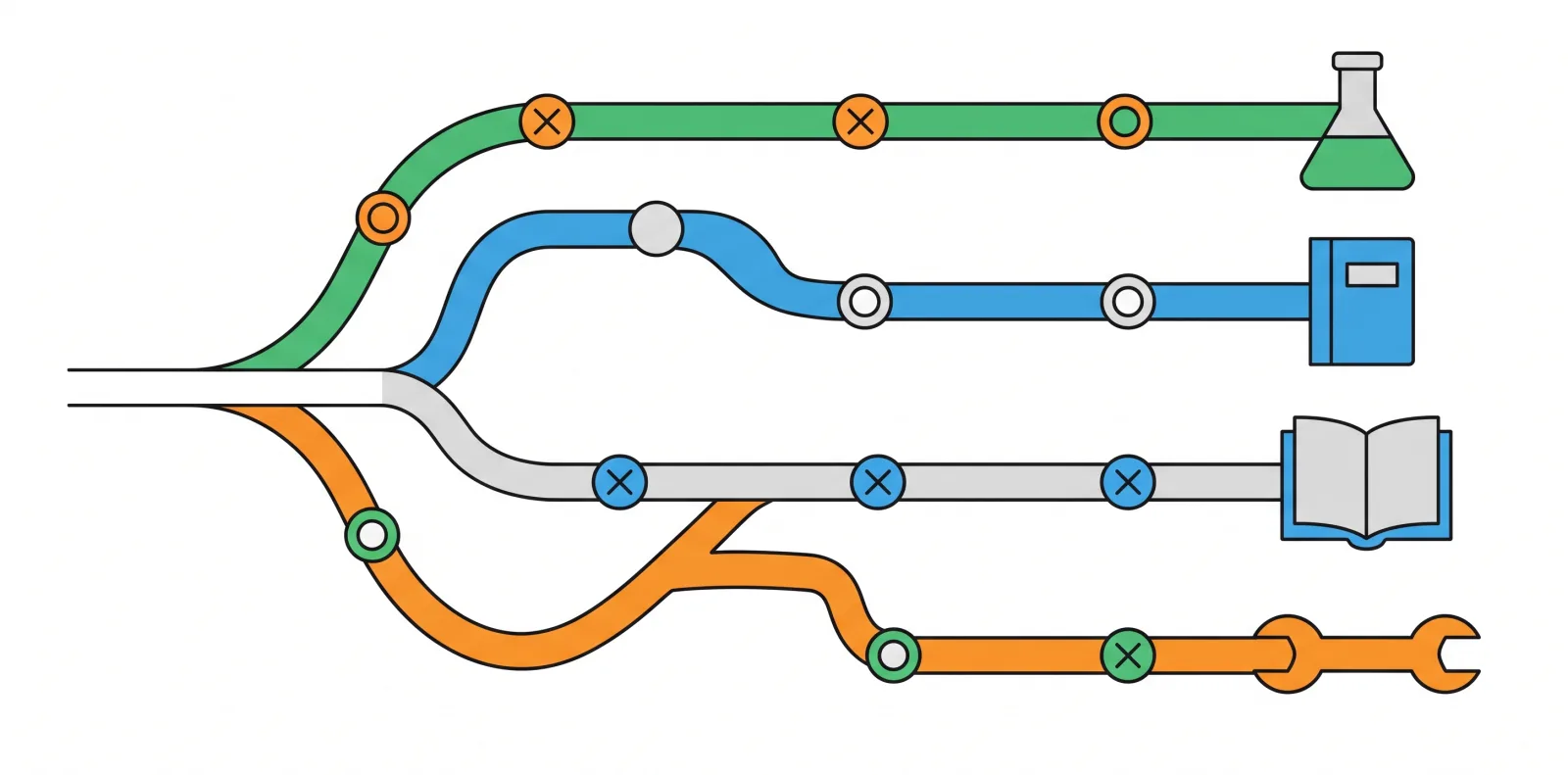
Science. Typically Physics, Chemistry and then either Mathematics or Biology or both, plus a language and an optional sixth.
What it is genuinely good for: engineering, medicine, pure sciences, research, architecture, pharmacy, agriculture, data science and a wide range of technical fields. It also keeps commerce and humanities degrees open, because those rarely exclude science students.
What it costs: it is the heaviest combination in terms of hours, and both major entrance routes attached to it are highly competitive. A student who takes science without interest, purely for the social approval, frequently underperforms and then has fewer options than if they had chosen well.
The honest test: do you enjoy solving problems where there is a definite answer and the work is in finding it? If yes, science suits you. If you took it because of what people would say, reconsider now rather than in Class 12.
Commerce. Typically Accountancy, Business Studies and Economics, with Mathematics as a crucial optional addition.
What it is genuinely good for: chartered accountancy and other professional accounting qualifications, company secretaryship, business and management degrees, economics if you take Mathematics, banking, finance, and the whole commercial sector. It is a serious, rigorous route with well-established professional qualifications attached, and it is consistently underrated by families who equate it with a fallback.
What it costs: some undergraduate economics programmes at strong universities require Mathematics, so commerce without it narrows the field considerably. Professional qualifications such as chartered accountancy are demanding and have low pass rates at early stages.
The honest test: are you interested in how organisations, money and markets work? Commerce is genuinely intellectually substantial if you engage with it and genuinely dull if you do not.
Humanities. Typically some combination of History, Political Science, Geography, Psychology, Sociology, Economics, English and increasingly Legal Studies, with Mathematics available as an option at many schools.
What it is genuinely good for: law, civil services, journalism, psychology, design, social work, public policy, international relations, teaching, research, and admission to a very wide range of undergraduate degrees in India and abroad. Several of the most competitive routes in the country, including law through CLAT and the civil services, favour exactly the reading, writing and reasoning that humanities subjects develop.
What it costs: the social perception, which is unearned but real and which some students find wearing. And, in the Indian context, a narrower set of directly vocational routes straight out of school, meaning the path is often longer and requires postgraduate study.
The honest test: do you like reading at length, arguing positions and writing? If yes, humanities will suit you and you will do well. The stigma is somebody else's problem and it is fading.
Vocational and skill-based routes. CBSE offers a substantial catalogue of skill subjects at senior secondary level, spanning technology areas such as Artificial Intelligence, Data Science, Web Applications and Information Technology; commerce areas such as Banking, Insurance, Financial Markets, Retail and Marketing; and service areas including healthcare, tourism, hospitality, agriculture, apparel, beauty and wellness, and several more.
These can be taken as an additional sixth subject alongside any stream, or in some combinations as one of the main five.
What they are genuinely good for: adding practical content, raising an aggregate where universities count them, providing early exposure to a field, and supporting an application where you can discuss a project you actually built.
What to watch: some universities exclude skill subjects from eligibility calculations, and a skill subject should never displace a subject required for the entrance route you are targeting. Verify against each university's admission bulletin before relying on one.
A Method For Choosing#
Work through this in order. It takes an evening and it is more useful than a year of anxiety.
Start with interest, honestly assessed. Not what you are told you are good at. Look at your Class 9 and 10 marks and, separately, at which homework you did not mind doing. Those two signals together are more reliable than either alone.
Then list five or six careers that genuinely appeal, even vaguely. For each, find out what degree it requires, and for each degree, find out what Class 12 subjects it requires. This is fifteen minutes of searching per career and almost nobody does it.
Then find the combination covering the most of your list. Very often one combination covers four or five of six, which resolves the decision immediately.
Then check the Mathematics question explicitly. Does any route on your list require it? If yes, or if you are genuinely undecided, take it. If none does and you actively dislike it, dropping it is a legitimate choice, made with information.
Then check what your school actually offers. Schools cannot timetable every combination. Find out which are genuinely available before building a plan around one that is not.
Then choose the sixth subject deliberately, for aggregate effect, for interest, or both.
And ignore the hierarchy entirely. The only stream that damages a student is the one chosen to satisfy somebody else. A student in the right subjects works harder, enjoys it more and performs better, and that outweighs every reputational consideration attached to stream names.
Reading Your Own Class 10 Marksheet For Signals#
Your Class 10 result contains more information about stream fit than most students extract from it, provided you read it properly rather than looking only at the aggregate.
Compare subjects against each other, not against the class. A student who scored eighty-two in mathematics and ninety-one in social science has a clear internal signal, even if both look good in isolation. The relative pattern across your own subjects is more informative than where you sat in the class ranking.
Separate effort from aptitude. Ask yourself, honestly, how many hours went into each subject. A high mark in a subject you studied for three hours a week is a different signal from the same mark in one you studied for ten. The subject that produced good results on modest effort is usually the one that suits how you think.
Look at what you enjoyed revising. This sounds unscientific and it is surprisingly predictive. Revision is a good test because nobody enjoys it much, so the subject you minded least is the one with genuine interest attached. That interest is what sustains you through two difficult years.
Discount a single bad paper. One poor result in an otherwise consistent subject is usually an event rather than a signal. A consistent pattern across the year, including your school tests, tells you far more than the board result alone.
Treat mathematics with particular care. Because it opens the most routes, the decision to drop it deserves more scrutiny than any other. Ask whether you found it genuinely difficult to understand, or whether you found it tedious, or whether it was taught badly. Those three have different implications. Genuine conceptual difficulty is a reasonable ground for dropping it. Bad teaching is not, since that problem may not follow you into Class 11.
And remember that Class 10 measures a narrow thing. It tests a particular set of subjects, taught in a particular way, examined under particular conditions. It does not measure your capacity for law, design, psychology, entrepreneurship, journalism or most of the things people actually do. Use it as one input among several, not as a verdict on what you are capable of.
The Conversations That Derail Good Decisions#
Most poor stream choices are not made by students. They are made in conversations around students, and recognising the patterns helps you handle them.
"What will people say?" This is the most common and least defensible reason to choose a stream. The people in question will have an opinion for about a week and will then think about something else. You will have the consequences for two years and beyond.
"Your cousin did science and look at them now." One person's outcome is not evidence. For every visible success in a stream there are many invisible people for whom it did not work, and the ones who struggled are not the ones held up as examples at family gatherings.
"You can decide later, just keep options open." Partly reasonable and partly a way of avoiding the decision. Keeping options open is genuinely valuable, which is the argument for taking Mathematics. But taking a full science combination you dislike in order to defer a choice usually produces worse results and therefore fewer options, not more.
"Commerce and humanities are for students who cannot do science." Simply false, and the belief damages everybody. It pushes unsuited students into science, where they underperform, and it makes students who chose well feel apologetic about a good decision.
"The market is changing, take whatever is in demand." Markets change over the four to six years between your stream choice and your entry into work. Choosing purely on a current snapshot is a forecast, and forecasts about which fields will be in demand have a poor track record. Interest and capability are more durable predictors of doing well.
How to handle these conversations. Bring a written list of the careers you are considering, the degrees they require and the Class 12 subjects those degrees specify. A researched plan changes the tone of a family discussion completely. It moves the conversation from what people think to what is actually required, and most families respond well to that.
Frequently Asked Questions#
Can I change my stream after Class 11?#
Sometimes, within the first few weeks, subject to school approval and board registration deadlines. After that it becomes very difficult, since board registration occurs in Class 11 for the Class 12 examination. Decide carefully at the start rather than assuming a correction is available.
Is science the safest choice if I am undecided?#
Science with Mathematics keeps the widest range of routes open, which is a genuine argument. But it is also the heaviest workload, and a student who takes it without interest often underperforms and ends up with fewer real options than a well-chosen alternative would have given them.
Do I need Mathematics for economics?#
At many strong universities, yes, and it is the most common eligibility trap. Some programmes accept economics without mathematics, others require it explicitly. Check each university's admission bulletin for the specific programme you want.
Is humanities an easy option?#
No. A serious humanities course requires substantial reading, analytical writing and argument, which many students find harder than procedural subjects. The perception of ease is a prejudice, not an observation.
Can I take a skill subject alongside my main stream?#
Yes, usually as an additional sixth subject, and in some combinations as one of the main five. Verify that your target universities count it for eligibility, and never let it displace a subject required for your intended entrance route.
What if my school does not offer the combination I want?#
Find out early, because timetabling constraints are real and usually not negotiable. Options are to choose the nearest available combination, or to consider a different school if the gap is genuinely decisive and a move is practical.
Does stream choice determine my career permanently?#
No. It determines which undergraduate routes are directly available, which is narrower than a career. People move between fields constantly, and postgraduate study, professional qualifications and lateral entry all exist. Stream choice matters, but it is a door rather than a destination.
How do I decide if my family disagrees with me?#
Bring evidence rather than argument. List the careers you are considering, the degrees they need and the subjects those degrees require. A decision presented as a researched plan is received very differently from one presented as a preference, and families are usually more reasonable when shown the actual requirements.