A Report Card With No Marks, Partly Written By Your Classmates#
Imagine handing your family a report card that contains no percentage, no rank, no subject-wise total. Instead there are descriptions. Your teacher has written about how you approach a problem when you get stuck. Two classmates have recorded whether you share materials and listen when others speak. You have written your own account of what you found difficult this term. Your parents have contributed observations about what you do at home.
For a lot of Indian families, the first reaction is straightforward alarm. Where are the marks? How will we know where the child stands? How will anyone compare?
That reaction is completely understandable and also, in a sense, the entire point. The Holistic Progress Card is designed to interrupt exactly the habit of asking "where does my child stand" and replace it with "what can my child do, and what comes next".
Whether it succeeds depends on things no policy document controls, which we will come to. But first, what it actually is.
Background: Where The HPC Came From#
The National Education Policy 2020 argued that Indian school assessment had drifted into a narrow and damaging pattern: high-stakes examinations testing recall, a single summary number describing a whole child, and a coaching industry built around optimising that number.
Its proposed replacement was assessment that is formative rather than only summative, and that covers more than academic recall.
Summative assessment happens at the end and summarises performance. A final examination is summative.
Formative assessment happens during learning and feeds back into it. A teacher noticing that a child has misunderstood a concept and addressing it that week is formative.
To implement this, the policy proposed a national assessment body. PARAKH, standing for Performance Assessment, Review, and Analysis of Knowledge for Holistic Development, was established as a standard-setting body under NCERT. Among its outputs is the Holistic Progress Card.
PARAKH developed HPC formats stage by stage, beginning with the Foundational Stage and extending to the Preparatory, Middle and Secondary stages, each adapted to what is developmentally appropriate at that age.
Two more terms:
Descriptor. A written description of a level of performance, used instead of a mark. "Can solve two-step word problems independently" is a descriptor. "17 out of 20" is a mark.
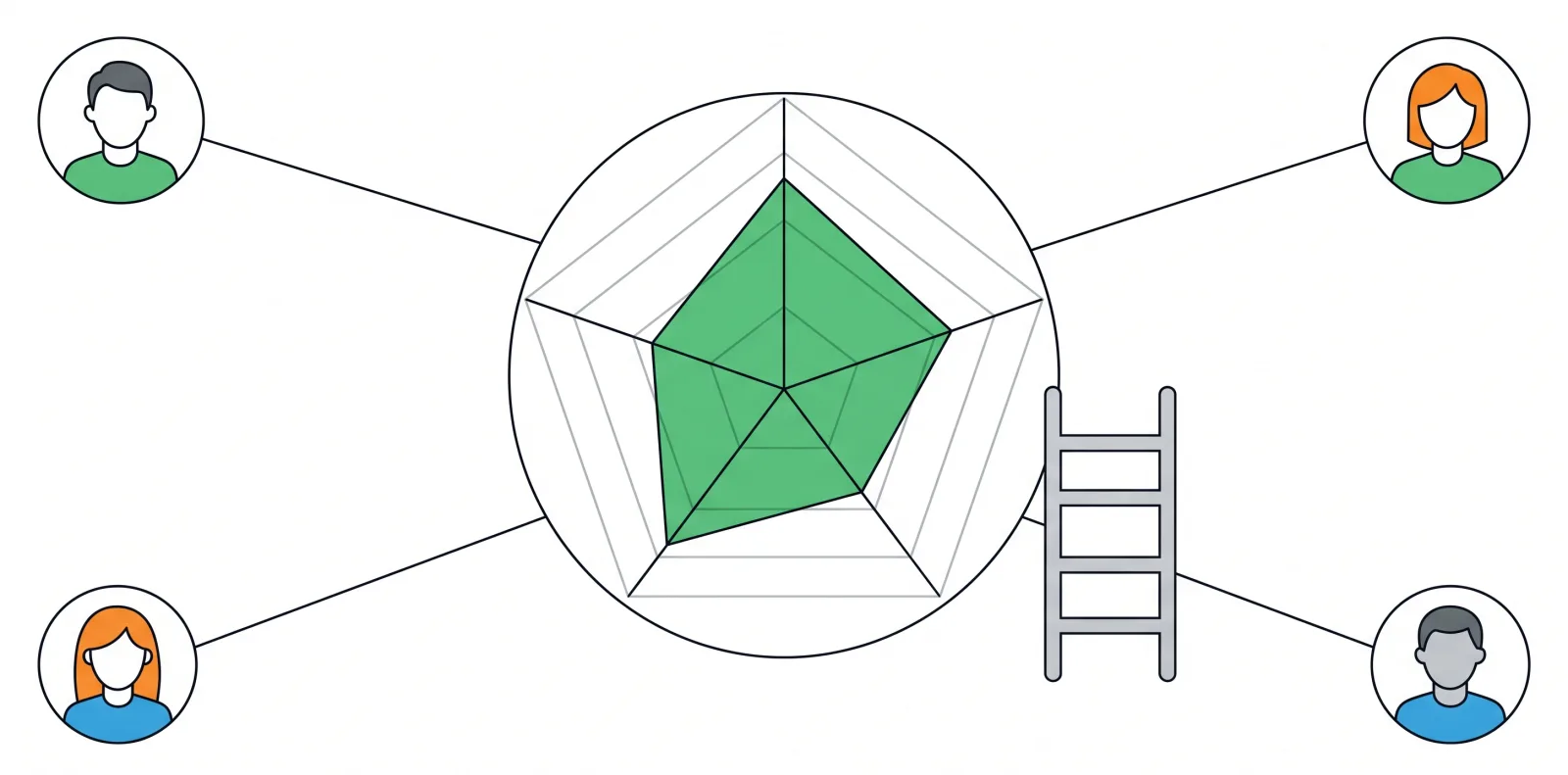
Three-hundred-and-sixty-degree assessment. Gathering evidence from multiple viewpoints rather than one. In the HPC this means the teacher, the student themselves, peers, and parents.
What Is Actually On The Card#
The structure varies by stage, but the architecture is consistent.
Multiple domains, not just subjects. Rather than a list of subjects with marks, the card describes development across broad domains. These typically include cognitive development, meaning reasoning, problem-solving and subject learning; socio-emotional development, meaning how a child manages emotions, works with others and handles setbacks; physical development and wellbeing; and creative and aesthetic development. At later stages, subject-specific learning outcomes become more prominent.
Descriptor levels rather than marks. Performance in each area is recorded against a small number of named levels, commonly a four-level scale running from beginning through developing and proficient to advanced. The exact labels vary by stage and document, so check the format your school uses. The important feature is that each level has a written description of what it looks like, so a parent can read what the child can currently do rather than decoding a number.
Multiple assessors. The teacher's assessment is the anchor, but the card also captures the student's own reflection, structured peer input, and parent observations. Peer assessment at primary level is usually simple and specific, such as whether a classmate shares materials or helps when asked, rather than any judgement of academic ability.
Evidence and examples. Good HPC practice includes actual samples of work, teacher observations of specific incidents, and records of projects, rather than only ratings.
An aspirations element at senior stages. At secondary level the card can include the student's stated interests and career thinking, with the intention of making the conversation about direction rather than only about performance.
How It Differs From The Report Card You Grew Up With#
| Feature | Traditional report card | Holistic Progress Card |
|---|---|---|
| Unit of reporting | Marks or grades per subject | Descriptor levels across multiple developmental domains |
| Who assesses | The teacher alone | Teacher, student, peers and parents together |
| What is measured | Recall and performance in written tests | Understanding, application, collaboration, persistence, creativity and wellbeing alongside subject learning |
| Comparison | Explicit, through ranks, percentages and class averages | Deliberately de-emphasised, with progress measured against the child's own earlier position |
| Timing | Usually end of term, summarising past performance | Continuous through the year, feeding back into teaching |
| What a parent learns | Where the child stands relative to others | What the child can currently do and what they should work on next |
| Main weakness | Reduces a complex child to a single number, rewards memorisation | Depends heavily on teacher time, training and honesty, and is harder to compare across schools |
That final row is the honest one, and we should stay with it.
The Case For It, Made Properly#
It measures things that matter and were previously invisible. A child who is patient, collaborative, persistent when stuck and curious has qualities that predict adult outcomes at least as well as recall does. The traditional report card recorded none of it. Making these visible tells families something genuinely useful.
Formative feedback changes teaching. The strongest evidence in education research for improving learning concerns feedback that arrives while there is still time to act on it. A system that requires teachers to observe, describe and respond during the year rather than only rank at the end pushes in exactly that direction.
It reduces a documented harm. Ranking children publicly from an early age is associated with anxiety, disengagement among those persistently near the bottom, and a fixed view of one's own ability. Removing rank from primary reporting is a deliberate response to that, and it is not a soft-headed one.
Self-assessment builds a real skill. Being able to judge your own work accurately is a capability that matters for the rest of your life, and it is almost never taught. The HPC's reflection sections are, at their best, practice in it.
It gives parents something actionable. "Reads fluently but struggles to infer meaning beyond the literal" tells a parent what to do on a Sunday afternoon. "72 per cent" does not.
The Problems, Stated Just As Plainly#
Balance requires taking the difficulties seriously, because they are real and teachers have been vocal about them.
It is heavy on teacher time. Writing individualised descriptive assessments for forty or fifty children, several times a year, across multiple domains, is a substantial workload on top of teaching. Where class sizes are large and administrative support is thin, the predictable outcome is that descriptors get copied, standardised and drained of meaning. A card full of identical sentences for thirty children is worse than a mark, because it looks personal and is not.
Training determines everything. Observing socio-emotional development reliably is a skill. Without proper training, ratings drift towards impression, and impressions carry the biases we all have about which children are attentive, articulate or well presented. This risk is documented in assessment research and it applies here.
Comparability suffers. Descriptors are not standardised across schools in the way marks pretend to be. When a student changes school, or when a selection process needs a comparable measure, descriptor-based records are harder to use. This is a genuine trade-off, not a fixable bug, and it is why marks persist at stages where selection happens.
Families may not adapt. If parents continue to ask only "how many marks", and schools respond by quietly maintaining a parallel marks system, the HPC becomes paperwork rather than reform. This has happened to previous assessment reforms in India, notably the earlier continuous and comprehensive evaluation system, which was widely criticised for becoming a documentation exercise and was eventually rolled back in its original form.
That precedent deserves attention. The HPC is not the first attempt at continuous, descriptive, holistic assessment in Indian schools. The previous attempt struggled precisely on workload, training and family expectations. Whether this one succeeds depends on whether those three problems are addressed rather than assumed away.
Peer assessment needs careful handling. With young children it works when it is specific and behavioural. It goes wrong when it becomes a popularity judgement, and it requires a teacher actively managing the process.
How To Read One Without Panicking#
If you receive an HPC, for your own child or a younger sibling, here is how to use it.
Read the descriptors, not the level. The level is a summary. The written description tells you what the child can actually do, and it is the part with information in it.
Look for specific evidence. A good card references particular work, particular incidents, particular improvements. A card with only ratings and no examples has been filled in rather than written.
Compare against the same child's earlier card, not against another child. That is the comparison the instrument is designed for, and it is the one that tells you whether things are moving.
Treat the socio-emotional section seriously. Parents tend to skim it in search of the academic part. It is frequently where the most useful information sits, particularly about how a child handles difficulty.
Read the child's own reflection carefully. It shows how they see themselves, which is worth knowing, and it sometimes reveals worries that have not been said out loud.
Ask the teacher one question. What is the single thing that would most help this child in the next term? A good teacher will have an answer ready, and it will be more useful than the entire document.
Do not demand a mark. If a school has moved to descriptors and you press for a percentage, you are asking a teacher to reconstruct exactly the thing the system is trying to move past. Ask what the child can do instead.
Frequently Asked Questions#
Does the Holistic Progress Card mean marks have been abolished?#
No. It changes how learning is reported at school level, particularly in earlier stages. Board examinations at Class 10 and 12 continue to produce marks, and selection processes still use them. The HPC sits alongside that rather than replacing it everywhere.
Who fills in the Holistic Progress Card?#
Primarily the teacher, with structured contributions from the student, classmates and parents. The intention is a rounded picture rather than a single viewpoint.
What do the descriptor levels mean?#
They describe what a child can currently do, typically on a four-level scale running roughly from beginning through developing and proficient to advanced. Exact labels vary by stage and document, and each level comes with a written description that is the substantive part.
Is peer assessment fair to young children?#
It works when it is specific and behavioural, such as whether a classmate shares materials or helps when asked, and when a teacher actively manages the process. It goes wrong when it drifts into general judgements about ability or popularity.
How will colleges compare students without marks?#
They will not, at the stages where the HPC applies. Selection for higher education continues to use board examinations and entrance tests, which remain marks-based. The HPC is about how learning is described during schooling, not about how admission is decided.
Is this the same as the old continuous and comprehensive evaluation system?#
It shares aims but is a different instrument with a different design, developed by PARAKH under the current policy framework. The earlier system's difficulties with workload and documentation are, however, exactly the risks to watch here.
What should I do if the descriptors look identical for every child in the class?#
Ask the teacher for specific examples of your child's work and behaviour. Identical descriptors usually indicate workload pressure rather than indifference, and a direct conversation often produces the individual picture the card did not.
Where can I see the official format?#
PARAKH and NCERT publish the Holistic Progress Card formats for each stage, and CBSE issues circulars to affiliated schools on implementation. Ask your school which stage format it uses and request a blank copy, which most schools will share.