No, Your Eight-Year-Old Is Not Being Taught To Build A Chatbot#
The moment a school announces artificial intelligence in the primary curriculum, two reactions arrive almost simultaneously.
The first is panic. My child can barely do long division and now they want neural networks? Is this another expensive fad that will produce a laptop requirement and a fee increase?
The second is inflated expectation. My child is learning AI in Class 4, so presumably by Class 8 they will be building things and we are safely ahead of the curve.
Both reactions misunderstand what is being introduced, because both assume "AI curriculum" means teaching children to build artificial intelligence systems. It does not. What is being introduced is something considerably more sensible and, honestly, more useful: a structured way of thinking about problems, and a basic literacy about the automated systems children already interact with several dozen times a day.
Most of it happens without a computer. Some of the best parts happen with paper, blocks and conversation. And whether it works will depend almost entirely on whether teachers are trained properly, which is the part nobody puts in the announcement.
This explainer is written for anyone who needs to understand what is actually happening: parents of younger children, older siblings who end up doing the homework help, and students of education who will be teaching this material in a few years.
Background: Where This Came From#
Two documents drive this change, and it helps to know what they are.
The National Education Policy 2020. India's overarching education policy, replacing a framework from 1986. It proposed substantial restructuring of school education, including a shift from rote learning towards conceptual understanding, the introduction of coding and computational thinking from the middle school stage, and greater emphasis on experiential and multidisciplinary learning.
The National Curriculum Framework for School Education 2023. The document that translates policy into curricular structure, specifying stages, learning outcomes and pedagogical approaches. It organises schooling into four stages: Foundational, Preparatory, Middle and Secondary.
CBSE, as a school board, then issues circulars and curriculum documents implementing these frameworks in its affiliated schools. The introduction of computational thinking and AI concepts across primary and middle years is part of that implementation.
Two crucial definitions, because everything depends on them.
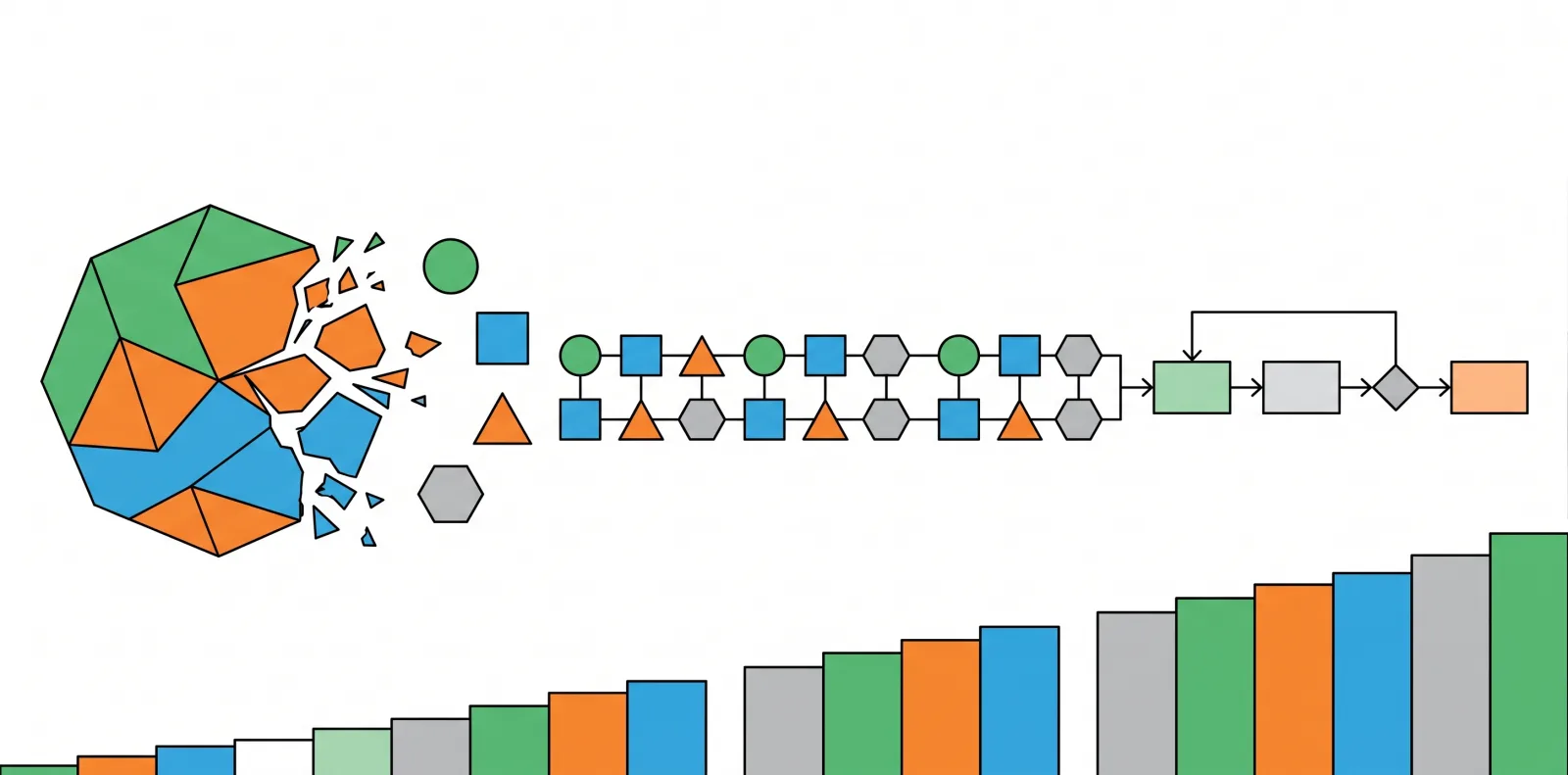
Computational thinking is a problem-solving approach borrowed from computer science, but it is not programming. It has four components, and once you see them you will notice you already use them.
Decomposition means breaking a large problem into smaller parts. Planning a birthday party becomes guest list, food, decorations, timing.
Pattern recognition means noticing similarities and regularities. Spotting that every multiplication table has a structure, or that a story follows a familiar shape.
Abstraction means ignoring irrelevant detail to focus on what matters. A map of a metro system does not show the actual geography, because for the purpose of catching a train, geography is noise.
Algorithms means designing a clear, ordered sequence of steps that solves the problem reliably. A recipe is an algorithm. So are the instructions for long division.
AI literacy at school level means understanding what artificial intelligence is, recognising where it appears in everyday life, grasping that it learns from data, understanding that it can be wrong and can be biased, and thinking about when its use is appropriate. It does not mean building models.
What Children Actually Learn, Stage By Stage#
The progression runs from concrete to abstract, from unplugged to digital, and from description to creation.
The early years, roughly Classes 3 to 5. Much of this is deliberately unplugged, meaning no computer at all. Children sort objects by attributes, continue and create patterns, put a set of instructions in the right order, spot what is wrong with a sequence, and describe how to do something precisely enough that another person could follow it. A classic activity has a child write instructions for making a sandwich, then watch the teacher follow them literally and comically fail, which teaches algorithmic precision better than any lecture.
This is genuinely good pedagogy. It builds logical structure at an age when children are receptive to it, and it does so through activity rather than instruction.
The middle years, roughly Classes 6 to 8. Block-based programming typically appears here, using visual environments where children drag and connect coloured blocks rather than typing code. This removes syntax errors from the learning process and lets children concentrate on logic. They build simple animations, games and simulations.
Alongside this, AI literacy begins in earnest. Children learn that many systems they use daily, including recommendations on video platforms, voice assistants, face unlock and map routing, involve automated decision-making. They learn that such systems learn from data. They do simple classification activities, sometimes on paper, to understand what training means. And, importantly, they encounter the idea that these systems can be wrong and can be unfair, which leads into age-appropriate conversations about bias and ethics.
By Class 8, some schools run short project modules where students build a very simple AI-flavoured project using accessible tools, and CBSE has previously offered modular AI content at this level.
Where it leads. At secondary level, CBSE already offers Artificial Intelligence as a skill subject at Classes 9 and 10 and at Classes 11 and 12, with its own syllabus and examination. The primary and middle school work is the on-ramp to that, and also a foundation for anyone who never takes the subject formally.
Why This Is Worth Doing, Honestly Assessed#
Three genuine arguments in favour.
Computational thinking transfers. Decomposition, pattern recognition, abstraction and algorithmic reasoning are useful in mathematics, science, language and ordinary life. A child who can break a problem apart systematically is better at word problems, better at essay planning and better at debugging their own mistakes. This benefit does not depend on anyone becoming a programmer.
AI literacy is now basic civic literacy. Children already live inside automated recommendation and ranking systems. Understanding that a feed is chosen by an algorithm trained on behaviour, rather than being a neutral window on the world, is a genuinely protective piece of knowledge. So is understanding that a system can be confidently wrong.
Early exposure widens participation. Students who encounter computing only in Class 11 tend to be those whose families already had computers and expectations. Putting it in the general curriculum from Class 3 reaches children who would otherwise never meet it, and the evidence from other education systems suggests early exposure affects who thinks the subject is "for them".
Now the honest concerns, because they are substantial.
Teacher preparation is the binding constraint. A curriculum is only as good as the person delivering it. Most primary teachers were not trained in computational thinking, and AI concepts are new to a large proportion of school staff. Without sustained, practical training, the risk is that the subject is taught as vocabulary to be memorised, which would be the exact opposite of its purpose. This is the single biggest threat to the initiative and it deserves more attention than the curriculum design itself.
Infrastructure is uneven. Block programming needs functioning computers and, often, internet access. Schools vary enormously in whether they have these in working order and in sufficient numbers. The unplugged portions of the curriculum are partly a sensible response to this, but the digital portions are not optional forever.
The risk of premature assessment. If this content becomes examinable in a conventional way at primary level, it will be reduced to definitions to memorise, and a subject designed to teach thinking will be taught as recall. Several educationists have raised exactly this concern.
The commercial pressure. Announcements of technology in schooling reliably produce a market of vendors selling robotics kits, tablets, subscriptions and branded "AI labs", not all of which are educationally necessary. Parents should be sceptical of any requirement that appears immediately after a curriculum announcement and costs a large amount.
What To Ask Your School#
Specific questions produce useful answers.
Who is teaching this, and what training have they received? A named teacher with a described training programme is a good sign. A vague answer about the computer teacher handling it is less reassuring.
How much of it is unplugged? A good primary programme has substantial screen-free content. If everything is on a device, the pedagogy is probably weaker, not stronger.
How is it assessed? Ideally through projects, activities and observation rather than written tests of terminology at primary level.
What equipment is genuinely required, and what is optional? Ask for this in writing before agreeing to any purchase.
Can I see the year's plan? A school that has thought this through will have one. A school that has not will produce a brochure.
What is the ratio of children to working computers during a session? Six children sharing one machine is not a practical programming lesson.
What Parents And Older Siblings Can Do At Home#
None of this requires a computer or any purchase.
Cook together and talk about the recipe as a sequence. What happens if you swap two steps? What happens if a step is ambiguous? That is algorithmic thinking.
Play games that involve rules and strategy. Chess, card games and logic puzzles build exactly the reasoning the curriculum targets.
Ask "how do you think it knew that?" when a video platform recommends something, or a phone suggests a word. It opens a genuinely interesting conversation about data and prediction.
Let them explain things to you precisely. Ask a child to teach you how to do something they know, and follow their instructions literally. The gaps they discover are the lesson.
Resist the urge to buy a course. At primary level, the highest-value activity is conversation and structured play, not a subscription. Paid courses become more relevant later, if the child develops a genuine interest.
Five Misconceptions Worth Clearing Up#
These circulate widely and each one leads families towards a bad decision.
"My child will be behind if their school has not started this yet." Implementation rolls out over time and depends on teacher training and infrastructure. A school introducing it a year later than another is not disadvantaging its students in any measurable way, because the content at this level is foundational and the skills build through many routes. Ask about the school's plan rather than panicking about its timing.
"This means my child should start learning Python now." At primary level, no. The reasoning skills the curriculum targets are built through activity, conversation, puzzles and structured play. A seven-year-old learning programming syntax is learning the least transferable part of computing. If genuine interest develops later, the syntax takes weeks.
"An expensive robotics kit or tablet will help." Rarely, at this stage, and often the money is better spent on books and time. The evidence on educational technology consistently shows that outcomes depend on how a tool is used rather than on its presence. A trained teacher with paper beats an untrained one with a laboratory full of devices.
"AI in the curriculum means my child will get a technology career." It means they will understand the systems around them, which is valuable regardless of what they do. Career outcomes at this distance are not predictable from a primary school subject, and treating a Class 4 module as career preparation puts pressure on a child for no benefit.
"This is just another fad that will be dropped." Possibly, in its current form, since curricula change. But the underlying skills, breaking problems apart, spotting patterns, reasoning about procedures and understanding that automated systems can be wrong, are durable regardless of what the subject is called in ten years. That part is worth the effort even if the framework is revised.
The sensible posture is interest without anxiety. Ask the school good questions, support the thinking at home through conversation, and resist anything that arrives with an invoice attached.
Frequently Asked Questions#
Is my child learning to code in Class 3?#
No, not in the conventional sense. Early primary work focuses on sequencing, sorting, patterns and giving precise instructions, usually without a computer. Block-based programming typically appears in the middle school years.
What is computational thinking, in one sentence?#
A structured way of solving problems by breaking them into parts, spotting patterns, ignoring irrelevant detail and designing clear step-by-step procedures. It is useful well beyond computing.
Does my child need a laptop or tablet for this?#
Not for the primary stage, where much of the content is designed to work without devices. Middle school block programming does need access to a computer, usually provided by the school. Ask what is genuinely required in writing before buying anything.
Will this be examined?#
Assessment approaches vary by stage and school, and CBSE's own guidance favours activity and project-based assessment for younger classes over conventional written tests. Ask your school specifically how it is being assessed.
Is AI as a school subject the same as the Class 9 and 10 AI skill subject?#
No. The primary and middle school content is foundational literacy. CBSE separately offers Artificial Intelligence as a formal skill subject at secondary and senior secondary level, with its own syllabus and examination, which builds on this foundation.
My child's school has not started this. Should I be worried?#
Not immediately. Implementation rolls out over time and varies between schools depending on teacher training and infrastructure. Ask the school about its plan and timeline rather than assuming either negligence or urgency.
What is the biggest risk with this curriculum?#
Inadequate teacher training, which would turn a thinking-skills curriculum into vocabulary memorisation. The second risk is commercial pressure to buy equipment and subscriptions that are not educationally necessary.
Where can I read the official framework myself?#
On the CBSE website, which publishes curriculum documents and circulars for affiliated schools, and in the National Curriculum Framework for School Education published by NCERT. Read the primary sources rather than summaries, since details change between circulars.