Solving Forty Papers And Improving By Four Marks#
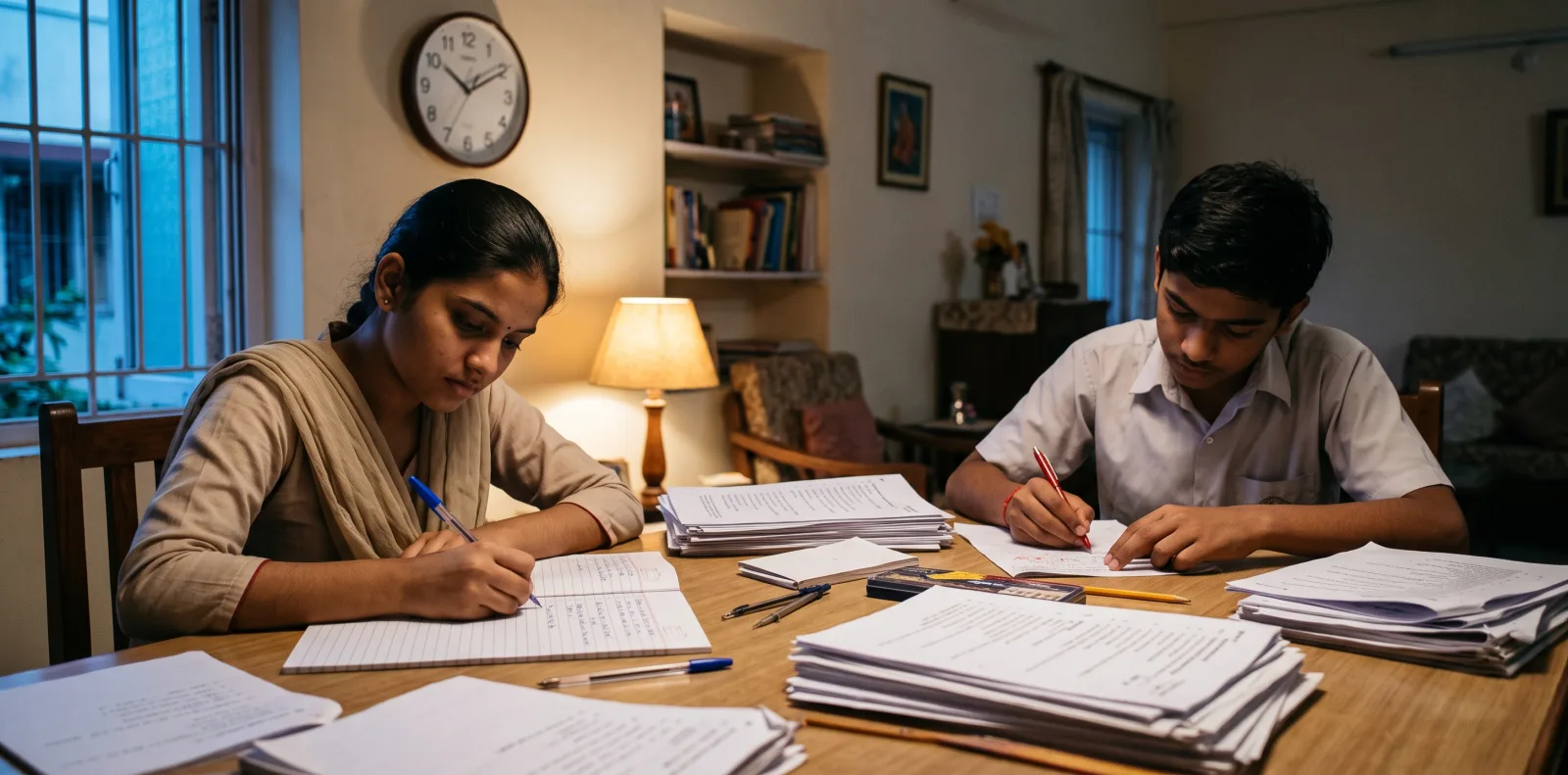
There is a specific kind of exhaustion that arrives around January in a Class 10 household. The student has solved a great many papers. There is a visible stack of them. Hours have gone in. And the score has barely moved.
The problem is almost never effort. It is that solving papers is being treated as the activity, when solving a paper is actually just the diagnostic step. The learning happens afterwards, in the twenty minutes most students skip, when you work out precisely why each mark was lost and do something specific about it.
The second problem is that sample papers and previous year papers are being used interchangeably, as though they were the same resource in different packaging. They are not. They answer different questions, and using only one of them leaves a real gap.
This article explains the difference properly, then gives you a sixty-day plan that uses both.
Background: What Each Resource Actually Is#
CBSE sample question papers. Published by CBSE each year, usually well before the examination, on the board's academic website. Each comes with a marking scheme, which is the official document showing the expected answer and how marks are distributed within it.
What a sample paper tells you: the current year's blueprint. How many questions of each type, how marks are distributed across sections, what proportion of the paper is objective, short answer, long answer and case-based, and how much weight competency-based questions carry. If the pattern has changed from last year, the sample paper is where you find out.
What it does not tell you: how questions are actually phrased across the full range of topics, or how examiners handle the many ways a student might answer. One sample paper per subject is a small sample.
Previous year question papers. Actual examination papers from earlier years, also available with marking schemes.
What they tell you: the real texture of questions. Which concepts appear repeatedly. How a topic is twisted when it appears for the third time. The language examiners actually use, which differs subtly from textbook language. And, with several years stacked up, which chapters genuinely carry weight regardless of what the syllabus percentage suggests.
What they do not tell you: this year's pattern, if it has changed. A paper from four years ago may have a structure that no longer exists.
The marking scheme is the resource almost nobody uses properly, and it is the most valuable of the three. It shows where marks sit inside an answer. Students routinely write correct, complete answers and lose marks because they omitted the step, the unit, the diagram label or the formula statement that the scheme allocates a mark to. Reading marking schemes is the fastest available route to recovering marks you are already capable of earning.
Competency-based questions are a term you will meet constantly. These are questions that require applying a concept to an unfamiliar situation rather than reproducing learnt material. A case-based question giving you a scenario and asking you to work out what happens is competency-based. Their share of CBSE papers has increased substantially, and they are where students trained purely on memorisation lose the most marks.
Using Them Together: The Division Of Labour#
| Resource | Use it to answer | Best used when | Common mistake |
|---|---|---|---|
| Current year sample paper | What is the shape of this year's paper, and how are marks distributed? | Early, to plan. Then again at the end, under full examination conditions | Solving it once in November and never returning to it |
| Marking scheme | Where exactly do marks sit inside an answer, and what am I omitting? | After every single paper you solve, without exception | Checking only whether the final answer matched |
| Previous year papers, last three to five years | How are questions actually phrased, and which concepts recur? | The main body of your practice, chapter by chapter then full-length | Solving papers from years with a different pattern and panicking about unfamiliar sections |
| Older previous year papers | Additional practice on specific weak chapters | Only for targeted chapter practice, never as a pattern guide | Treating a paper from many years ago as representative of the current examination |
The Sixty-Day Plan#
This assumes you have completed the syllabus at least once, which is the realistic position sixty days out. If you have not, compress phase one and start phase two on incomplete chapters anyway, because attempting questions on a half-learnt chapter teaches it faster than rereading.
Budget roughly five to six focused hours on weekdays and seven to eight at weekends. Sleep properly. A tired brain retains nothing and the last-week collapse that follows weeks of short sleep costs more marks than the hours gained.
Days 1 to 10: Diagnose#
Do not study yet. Find out what is actually wrong.
Solve the current year's sample paper for each major subject, one per day, under full timed conditions. Sit down, three hours, no phone, no textbook, no breaks beyond what the examination allows.
Then mark it yourself against the marking scheme, harshly. Award marks exactly as the scheme allocates them. If it gives a mark for stating the formula and you did not state it, you lost that mark. This is uncomfortable and it is the entire value of the exercise.
Build an error log. One page per subject, with three columns: what I got wrong, why I got it wrong, and what I will do about it. The middle column is the important one, and there are only four honest entries for it:
I did not know the concept. Requires relearning.
I knew it but made a calculation or careless error. Requires practice under time, not relearning.
I knew it but ran out of time. Requires speed work and better question ordering.
I knew it and wrote a correct answer but lost marks on presentation. Requires studying marking schemes.
The distribution of your errors across these four categories determines everything you do for the next fifty days, and it differs enormously between students. Two students with identical scores can need completely opposite plans.
Days 11 to 35: Repair#
Now attack the specific problems your log identified, chapter by chapter.
For concept gaps: read the NCERT chapter properly, work through every in-text and exercise question, then solve previous year questions on that chapter only, pulled from three to five years of papers. Topic-wise question compilations make this easy. Do not move on until you can solve the questions without referring back.
For careless errors: these are not fixed by studying. They are fixed by timed practice with deliberate attention. Solve sets of twenty questions under time pressure and log every careless mistake by type. Most students find their errors cluster: sign errors, unit conversion, misreading what was asked, transcription mistakes between rough work and answer sheet. Once you know your pattern, you can check specifically for it.
For timing problems: practise individual sections under time rather than full papers. If the long-answer section is taking too long, drill long answers alone with a stopwatch. Also fix your attempt order, which most students never consider. Answering in paper order is rarely optimal. Start with the section you are strongest and fastest at, to bank marks and build confidence, and leave the most difficult for after everything secure is done.
For presentation losses: spend one session per subject reading marking schemes alongside your own answers. Note exactly what earns marks. Then rewrite three of your own answers to match. This is the highest return per hour of anything in this plan, and hardly anybody does it.
Throughout this phase, maintain a daily thirty-minute revision slot for formulae, definitions, dates, equations and diagrams, whatever your subjects require. Spaced repetition genuinely works, and cramming these in the final week genuinely does not.
Days 36 to 52: Full-Length Practice#
Now build examination stamina.
One full paper per day, rotating subjects, under strict conditions at the same time of day as your actual examination. This last detail matters more than students expect. If your paper is at half past ten in the morning, practising at nine in the evening trains you to be sharp at the wrong hour.
Mark it the same day, against the scheme, and update your error log.
Watch your error log shrink. If a category is not shrinking, your approach to it is wrong and needs changing rather than repeating.
Include papers with the current pattern first, then older ones for additional practice, keeping clear in your mind which is which so an older structure does not unsettle you.
Take one day off per week. Genuinely off. Performance declines measurably without recovery, and the students who collapse in February are almost always the ones who never stopped.
Days 53 to 60: Consolidate#
Stop learning new material. It will not be retained well enough to be useful and the anxiety cost is high.
Revise from your error log, not from textbooks. Your error log is a personalised list of exactly what you get wrong. It is the most valuable document you have made.
Redo questions you previously got wrong, not fresh ones. Confirming that a fixed weakness is actually fixed is worth more than discovering a new one with a week left.
Do one final timed paper per subject, around day 55 to 57, then stop full papers.
Final three days: formulae, diagrams, definitions, key terms, and presentation rules. Sleep normally. Prepare your materials, admit card, stationery and route the evening before rather than the morning of.
Two Notes On The Current Examination Structure#
Competency-based questions need a different practice method. You cannot memorise your way through a question you have not seen before. What transfers is understanding the underlying concept well enough to apply it somewhere unfamiliar. When you solve one, ask yourself which concept it was testing underneath the scenario. That habit is what builds the ability.
On the two-attempt arrangement at Class 10. CBSE has moved to an arrangement giving students two examination opportunities. This is genuinely useful for a student who falls ill or has one bad paper. It is dangerous as a planning assumption. Preparing with a second attempt in mind reduces the seriousness of the first, and a first attempt taken casually is difficult to recover from psychologically. Prepare as though there is one examination. Treat the second as insurance you hope not to claim. Confirm the current rules on CBSE's own site, since details have been revised more than once.
Frequently Asked Questions#
Should I solve sample papers or previous year papers first?#
Sample papers first, to understand this year's structure and diagnose your weaknesses. Then previous year papers as the bulk of your practice. Return to the sample paper again near the end under full conditions.
How many previous years should I go back?#
Three to five years for full-length practice, since patterns shift over time. Older papers are still useful for targeted practice on specific chapters, provided you remember they may not reflect the current structure.
Where do I get official sample papers and marking schemes?#
From CBSE's own academic website, which publishes them for each subject each year. Use the official versions rather than commercially reprinted ones, which sometimes contain errors in the marking schemes.
Is it enough to read the answers instead of writing them?#
No. Writing under time is a separate skill from knowing the material, and most marks lost in board examinations are lost to time management and presentation rather than ignorance. Write full answers by hand, at examination speed.
How do I stop making careless mistakes?#
Log them by type for two weeks. Almost every student finds their errors cluster into two or three specific patterns. Once you know yours, you can check specifically for them in the final minutes of the examination.
How many hours a day should I study?#
Around five to six focused hours on weekdays is realistic and sustainable for most students, with more at weekends. Focused is the operative word. Eight distracted hours produce less than five attentive ones, and cutting sleep to add hours reduces retention.
What should I do in the last three days?#
No new material. Revise from your own error log, redo questions you previously got wrong, review formulae and diagrams, and sleep normally. Prepare your documents and materials the evening before each paper.
Does the two-attempt arrangement mean I can take the first attempt lightly?#
No, and treating it that way is a genuine risk. Prepare fully for the first attempt and regard the second as protection against illness or one bad day. Confirm the current rules directly on the CBSE website, as details have changed more than once.