Almost All Of This Is Preventable, And Almost Nobody Prevents It#
A candidate spends three months preparing, pays between ₹6,600 and ₹19,000, travels to a centre, and is turned away at the door because the name on their identification does not exactly match the name on their booking.
That is not bad luck. It is a preventable administrative failure, and it happens in India with depressing regularity.
The failures that actually end test days divide neatly into two groups. Administrative ones, which are almost entirely preventable by checking things a week in advance. And technical ones, which are partly preventable and otherwise have a defined procedure you should know before you need it.
The worst outcome in both groups is panic. A candidate whose screen freezes and who starts clicking randomly makes a recoverable situation worse. A candidate who knows to raise their hand and wait, or to stop and contact support, usually keeps their session.
The scenarios below are illustrative composites constructed to show the mechanics, not accounts of specific individuals. Procedures vary between tests and centres, so confirm the current rules for your own test in its official confirmation material.
Background: The Two Kinds Of Failure#
Administrative failures happen before you sit down. Identification that does not match, a booking for the wrong date or centre, arriving after the reporting deadline, or bringing something not permitted. These are checked at the door and there is usually no discretion available, because the rules exist precisely to prevent discretion.
Technical failures happen during the test. A frozen screen, a failing microphone, a power interruption, a dropped internet connection, or a proctoring interruption in home testing. These have procedures and the procedures generally protect you, provided you follow them rather than improvising.
The asymmetry is important. Administrative failures are your responsibility and are rarely recoverable. Technical failures are usually the provider's responsibility and are frequently recoverable. Which means your preparation effort should be weighted towards the first group.
Two terms worth defining:
Reporting time. The time by which you must arrive at the centre, which is earlier than the test start time, often substantially. Missing it is treated as a no-show.
Remote proctoring. Supervision of a home-based test through your webcam and software, with strict rules about your room, your desk and your behaviour.
The Failures, And What To Do#
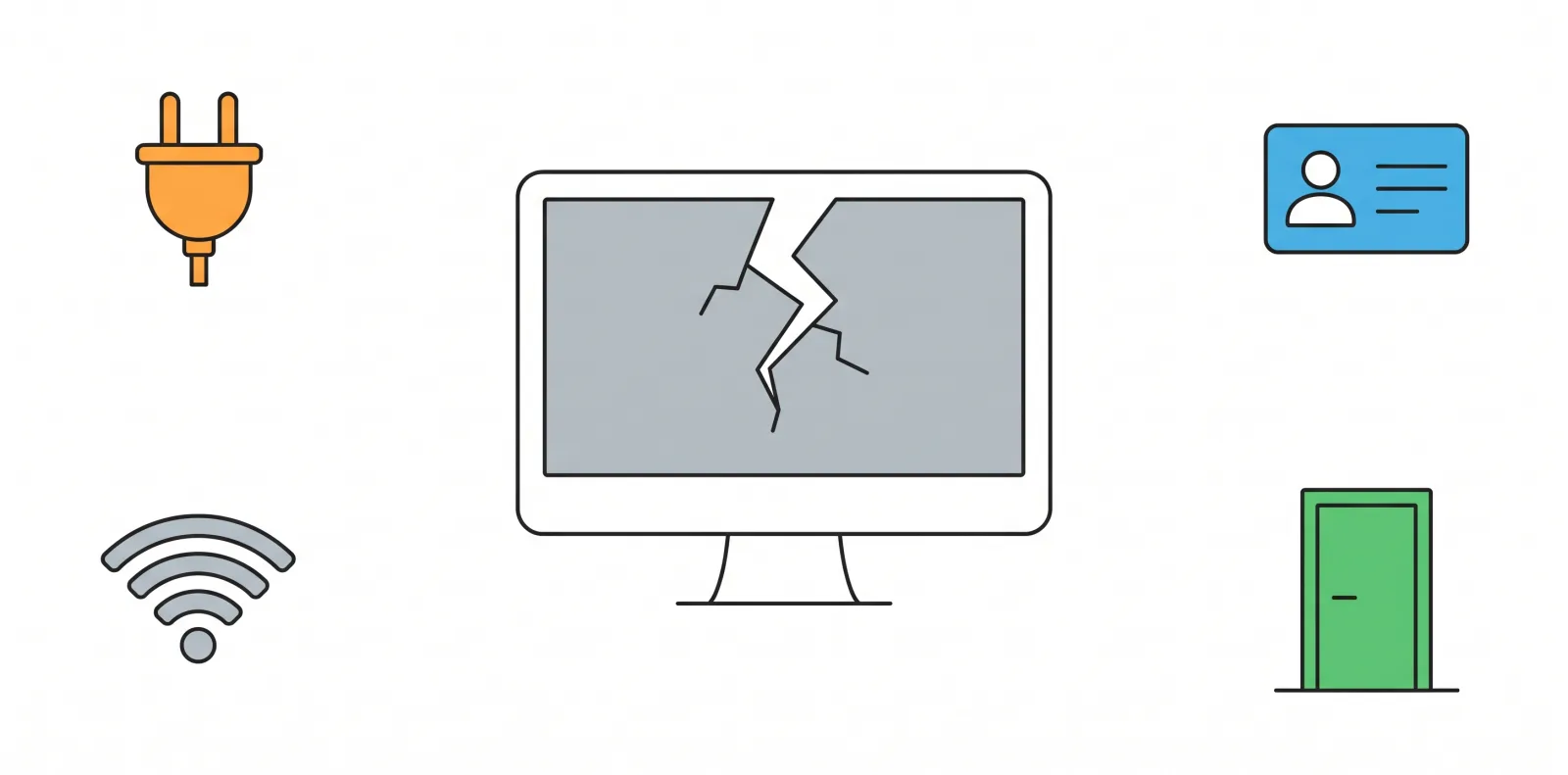
Notice the pattern. Everything in orange is preventable by you, in advance, in under an hour of checking. Everything in green and blue has a procedure that protects you if you follow it.
The single most important instruction on that chart is do not restart anything. A candidate who reboots a frozen machine themselves can lose the session that centre staff would have recovered.
Illustrative Scenarios#
These are constructed to show the mechanics, not accounts of specific people.
The identification mismatch. A candidate books using the name as it appears on their school certificate, which includes an expansion of an initial. Their passport uses the initial. At the door the names do not match and entry is refused. The prevention is to book using exactly the name on the identification document you will carry, character for character, and to carry that specific document rather than an alternative.
The frozen screen mid-section. Twenty minutes into a computer-delivered test, the screen stops responding. The candidate who raises their hand and waits has the session restored by centre staff with the clock adjusted. The candidate who restarts the machine themselves creates a different and much less recoverable problem.
The power cut. A neighbourhood outage during a computer-delivered test at a centre. Centres have procedures and backup arrangements, and the correct response is to stay seated, stay quiet and let staff follow them. Leaving your seat is the thing most likely to complicate matters.
The interrupted home session. A family member opens the door twenty minutes into a remotely proctored test. Depending on the test and the circumstances, the session may be flagged for review or voided. The prevention costs nothing: tell the household, put a note on the door, and lock it if you can.
The microphone that was not recording. A candidate completes a speaking section and discovers afterwards that nothing was captured. Equipment checks exist at the start precisely to catch this, and the time to raise a concern is then, not after the section.
The Preparation Checklist#
Do this a week ahead, not the night before.
Check your identification against your booking, character for character. Spelling, initials, expansions, spacing. This single check prevents the most common test-day failure in India.
Confirm which identification document is required, since tests differ and some accept only a passport for particular purposes. Check that it is valid and not expiring before your test date.
Confirm the centre address and the reporting time, which is earlier than the test time. Plan your journey with a substantial margin, particularly in cities where traffic is unpredictable.
Check what you may bring and what you may not. Most centres permit almost nothing at your desk, and the process of depositing belongings takes time you should have allowed for.
For home testing, prepare the environment days ahead. A private room, a cleared desk, a working camera and microphone, tested internet, and identification to hand. Run the official equipment check well before the day.
For home testing, prepare the household. Tell everyone the time, put a note on the door, and arrange for the doorbell and the dog. The commonest home testing failure is human, not technical.
And have a backup plan for power and connectivity if either is unreliable where you live. A candidate whose electricity supply is intermittent should test at a centre regardless of convenience.
If Something Goes Wrong Anyway#
Report it immediately, on the day, at the centre or through the official support channel. A complaint raised on the day carries far more weight than one raised when scores arrive.
Write down what happened while you remember it. Time, section, what you saw, what you did, who you spoke to. This is the document your complaint rests on.
Ask for a written acknowledgement from centre staff that an incident occurred. Verbal assurances are difficult to rely on later.
Use the official complaint route, which every test has, rather than social media. The formal channel is the one that can actually restore a session or arrange a retest.
Understand the remedies that exist. Depending on the test and the circumstances, these may include a rescheduled session at no cost, a refund, or a rescore. They rarely include compensation for anything beyond the test fee.
And know the timelines. Complaints and rescore requests have deadlines, frequently short ones. Check them immediately rather than waiting to see whether your score is acceptable.
Booking Mistakes Made Weeks Earlier#
Several test-day failures are actually booking failures that surface at the door. They are worth catching when they are still cheap to fix.
Booking the wrong test variant. Academic and General Training are different tests with different purposes, and a candidate who books the wrong one discovers it when their university rejects the score rather than at the centre. Check which variant your programme requires before paying.
Booking the wrong city or the wrong centre within a city. Large cities have several centres and the confirmation names one. Assuming it is the nearest is a mistake people make once.
Booking a date too close to your deadline. Work backwards: test date, results turnaround, score sending time, and a buffer for a possible retake. Candidates routinely leave no room for the second attempt they end up needing.
Not checking slot availability before planning. Availability varies considerably by city and season, and a test you cannot book in time is not an option regardless of its merits. Check before you commit to a test in your plan.
Missing the rescheduling deadline. Every test allows rescheduling up to a cut-off, usually for a fee. After the cut-off, the money is gone. If your circumstances are uncertain, know that date.
And booking under a name you will later change. Candidates who marry, or who correct a document, between booking and testing create a mismatch that did not exist when they paid. If a name change is pending, resolve it first.
The Week Before, Day By Day#
A short sequence that removes almost all remaining risk.
Seven days out. Re-read the official confirmation email in full, including the sections you skipped the first time. Check your identification against the booking character by character. Confirm the centre address and the reporting time.
Five days out. For home testing, run the official equipment check on the exact computer, headset and connection you will use. For centre testing, do a trial journey at the same time of day if the route is unfamiliar.
Three days out. Take your last full practice test, then stop taking full tests. Further heavy practice at this point adds fatigue rather than score.
Two days out. Tell the household about the test time if you are testing at home. Arrange the room. Charge everything. Check the weather and any local disruption that might affect travel.
The day before. Assemble identification, confirmation and anything permitted, in one place by the door. Light revision only. Sleep is worth more than another hour of practice at this point and candidates consistently trade it away.
The morning. Eat something. Leave earlier than you think necessary. Arrive before the reporting time rather than at it.
And accept that something small will go wrong, because it usually does. A queue is slower than expected, a locker is full, the room is cold. None of these affect your score unless you let them, and knowing to expect friction is most of the defence against it.
Frequently Asked Questions#
What is the commonest reason candidates are turned away?#
Identification that does not exactly match the booking. Names with initials, expansions or different spellings between documents cause this constantly, and there is usually no discretion available at the door.
What should I do if my screen freezes during the test?#
Stop and raise your hand for centre staff. Do not restart the machine yourself, because a session that staff could have restored may be unrecoverable after an unauthorised restart.
What happens if there is a power cut?#
Stay seated and let staff follow their procedure. Centres have defined arrangements for this, and leaving your seat is the action most likely to complicate the recovery.
What if someone walks into the room during a home test?#
Your session may be flagged for review or voided depending on the test and the circumstances. Prevention costs nothing: tell the household the time, put a note on the door, and lock it if you can.
My microphone was not recording. Can I do anything afterwards?#
Raise it immediately through the official channel, but the equipment check at the start exists precisely to catch this. Test your equipment properly at that point and report any doubt then rather than after the section.
Should I test at home or at a centre?#
At a centre if your power supply or internet connection is unreliable, regardless of convenience. Home testing removes travel and slot scarcity but makes your electricity and connection a single point of failure.
How do I complain if something goes wrong?#
Through the test's official complaint channel, on the day if possible, with a written record of the time, the section, what happened and who you spoke to. Ask centre staff for written acknowledgement of the incident.
What remedies are actually available?#
Depending on the test and the circumstances, a rescheduled session at no cost, a refund or a rescore. Deadlines for these requests are frequently short, so check them immediately rather than waiting for your score.