
Both Answers Are Right, For Different People#
A graduate reaches the end of the placement season without an offer, and receives two pieces of confident advice from two sets of well-meaning people.
Take anything. Get started, get experience, the first job does not matter, a gap on your CV will haunt you.
Do not settle. Spend six months learning something properly, enter the market with a real skill, a bad first job is harder to escape than no first job.
Both are correct for some people and wrong for others, and the advice you receive usually reflects the adviser's own history rather than your situation.
What actually separates the two outcomes is not the decision. It is the structure. A gap with a written plan, a deadline and a measurable output builds a career. A gap taken because nothing else turned up costs you a year and is visible to every subsequent employer. Those are the same decision executed differently.
This article is about telling them apart before you commit, rather than discovering the difference afterwards.
Background: How Employers Actually Read A Gap#
Students imagine that any gap is a permanent stain. The reality is more specific and more manageable.
A gap with a demonstrable output is barely a gap at all. Six months with a certification and a deployed project reads as deliberate. The interviewer's question is what you did, and you have an answer that is better than many employed candidates could give.
A gap with no output is the problem. Not because of the time itself but because the candidate cannot answer the question. "I was preparing" and "I was looking" are the answers that do damage, because they describe an intention rather than a result.
Short gaps attract little attention. A few months between graduation and a first role is ordinary and frequently goes unremarked.
Long gaps attract questions, and the questions are answerable. A year is long enough that you will be asked, and a clear factual account with something to show closes it.
And some gaps are formally screened. A number of employers, particularly in large-scale structured hiring, specify maximum permitted gaps in their eligibility criteria. This is a hard constraint rather than a matter of impression, and it is worth checking against the employers you actually want before deciding.
Two terms worth defining:
Demonstrable output. Something that exists at the end: a certification, a deployed project, a completed apprenticeship, published work. Distinct from time spent.
Opportunity cost. What you give up by choosing one path. For a gap year it is a year of income, experience and seniority; for a poor first job it is a year of learning.
Four Situations, Four Different Answers#
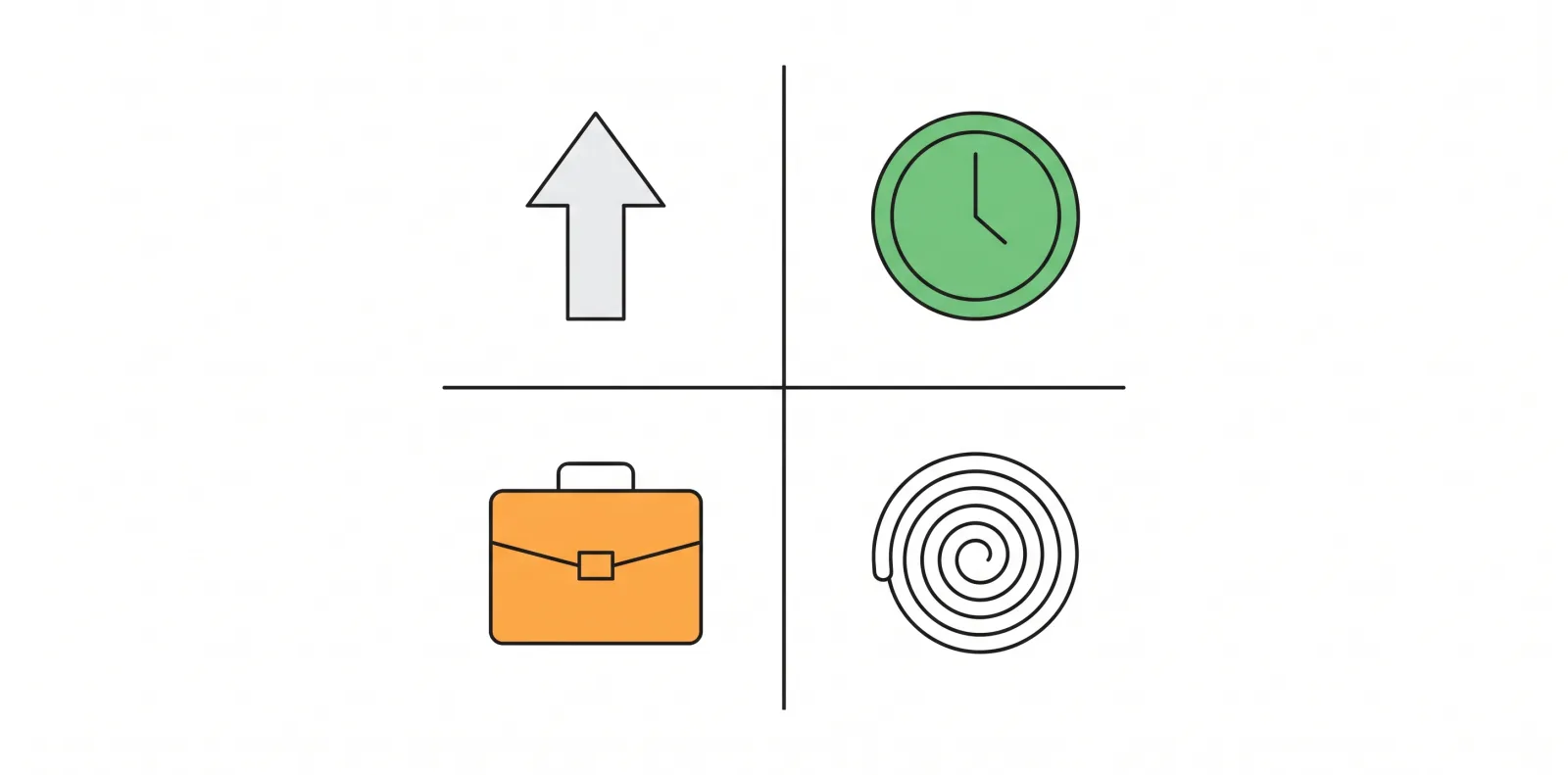
Only one quadrant supports a full gap, and it requires all four conditions: a specific plan, an absence of financial pressure, family agreement and a defined output.
The orange quadrant is where most damaged years actually happen. No immediate pressure, no plan, and a vague sense that something will turn up. Nobody chooses this deliberately. It is what a gap becomes when it was never structured.
And notice that two of the four quadrants recommend working while studying. For most graduates that is the honest answer, and it is covered below.
If You Take The Gap, Make It Defensible#
A gap succeeds or fails on the structure you put around it in the first week, not on your determination.
Write the plan down, with a date. What you will learn, in what order, and by when. Six months is a sensible maximum for a skill-building gap; beyond that the opportunity cost climbs sharply and the questions get harder.
Define the output before you start. A named certification obtained, a project deployed and maintained, a portfolio with two entries. Something that exists at the end and can be shown. An intention to "improve my skills" produces nothing checkable.
Treat it as a job with hours. Fixed start time, fixed working hours, five or six days a week. The failure mode of a gap is not difficulty but formlessness, and structure is the only defence.
Use the free routes first. The AICTE and EduSkills cohorts, the government SOAR programme, national academic online platforms. Spending large sums on private coaching at the start of a gap adds financial pressure to a period that needs none.
Build in public where you can. Work that is visible as it happens gives you something to point at and creates accidental opportunities.
Keep applying throughout. A gap for skill building is not a pause from the job market. Ten applications a week keeps the pipeline alive and means you can end the gap early if something good appears.
Set a review date at the halfway point and be honest at it. If two months in you have not started, the plan has failed and the correct response is to take a job, not to extend the deadline.
And agree it with your family explicitly, including the end date and what happens then. An unspoken gap generates pressure that makes the work harder, and that pressure is entirely avoidable with one conversation.
If You Take The Job, Take It Properly#
The alternative is not surrender, and treating it as such is how people end up resenting a perfectly reasonable job.
Any job is better than none in two specific ways. It ends the gap question permanently, and it teaches you how organisations actually work, which no course does.
But choose the least bad option deliberately. Between two ordinary roles, take the one with better learning, a better team or a clearer path, even at slightly lower pay. Over two years that choice compounds more than the salary difference.
Protect ten hours a week for the skill you wanted to build. This is the entire argument for this path. A year of employment plus a certification and a project is a stronger position than a year of either alone, and it is genuinely achievable at ten hours a week.
Set a review date, twelve or eighteen months out. Decide in advance what would make you stay and what would make you move. Without a date, an unsatisfying first job extends by default.
Use the employer's resources. Funded certifications, internal training, internal mobility to a better team. These are available and consistently unclaimed.
And be careful about service agreements. A bond that locks you in for two years changes this calculation considerably, and it is worth reading before signing rather than afterwards.
The Middle Path Most People Miss#
There is a third option between a full gap and an unrelated job, and it suits a large number of graduates.
An apprenticeship. Minimum stipends under the national schemes were revised on 1 April 2026 to ₹9,600 a month for technician apprentices, ₹10,900 for diploma holders and ₹12,300 for graduates. It is paid, the employer is statutorily required to train you, it ends with a recognised certificate, and it is not a gap.
The PM Internship Scheme, now paying ₹9,000 a month plus a ₹6,000 joining grant for a twelve-month placement at a company from India's top 500, for candidates meeting its eligibility criteria.
A funded postgraduate route, where one exists and where the subject is one you actually want rather than a way to defer the decision.
Part-time or freelance work alongside study. Less structured but it keeps income flowing and produces describable output, which is more than an unstructured gap gives you.
What all of these share is that they generate income, structure and a demonstrable output at the same time. That combination is what makes the gap question disappear entirely, and it is available to more graduates than realise it.
Explaining The Gap Afterwards#
Whatever you choose, at some point an interviewer will ask what you did between graduating and applying. Prepare for it rather than improvising.
Have a two-sentence version ready. What you set out to do and what you produced. "I spent five months building cloud skills, completed a certification and deployed a monitoring tool that I still maintain" closes the topic in ten seconds.
Lead with the output, not the reason. The interviewer is checking whether the time produced anything, not adjudicating your decision. Reasons invite follow-up questions; results do not.
Do not apologise for it. A defensive answer signals that you consider it a weakness, and the interviewer takes the cue. A factual one signals that you made a decision and executed it.
Be honest if part of it was difficult. A period of family illness, a health issue or a search that took longer than expected are ordinary human circumstances and most interviewers have seen them. A brief factual statement is fine; a long explanation is not.
Never fabricate employment. Employment history is routinely verified, and a discovered fabrication ends the process and sometimes the relationship with the employer permanently.
And if the gap genuinely produced nothing, say what you learned from that rather than inventing an achievement. A candidate who says the six months were unstructured and describes what they changed afterwards is more credible than one whose account does not survive a follow-up question.
Frequently Asked Questions#
Does a gap year damage my career?#
A gap with a demonstrable output does very little damage and is often read as deliberate. A gap with nothing to show is the problem, because the honest answer to what you did becomes an intention rather than a result.
How long is too long?#
Six months is a sensible maximum for skill building. Beyond a year the opportunity cost rises sharply and the questions become harder, and some employers screen on maximum permitted gaps as a formal eligibility criterion.
Will employers ask about it?#
For anything beyond a few months, yes. The question is answerable if you have a clear factual account and something to show. Prepare the two-sentence version rather than improvising it in an interview.
Should I take a job I do not want?#
Often yes, particularly under financial pressure. Choose the least bad option on learning and team rather than on salary, protect ten hours a week for the skill you wanted to build, and set a review date twelve to eighteen months out.
What makes a gap productive rather than wasted?#
Structure decided in the first week: a written plan with a deadline, a defined output that will exist at the end, fixed working hours, free learning routes, continued job applications, and a halfway review you answer honestly.
What is the middle path?#
An apprenticeship or a government internship scheme. Graduate apprentice minimums were revised on 1 April 2026 to ₹12,300 a month, and the PM Internship Scheme pays ₹9,000 a month plus a ₹6,000 joining grant. Both pay you, train you, produce a credential and do not count as a gap.
How do I decide if my family needs the income?#
Weight that heavily and take the job, without treating it as a failure. The skill plan survives at ten hours a week alongside employment. It is slower and it works, and financial stability makes it more likely to be completed rather than less.
What if two months in I have done nothing?#
Treat that as the plan having failed and take a job, rather than extending the deadline. This is exactly what the halfway review exists to catch, and acting on it is what prevents six months from becoming two years.