
Your Application Is Being Read For About Eight Seconds#
The uncomfortable truth about student applications is that almost nobody reads them properly the first time.
A recruiter with four hundred CVs for twelve internship places is not evaluating your potential. They are scanning for reasons to move you into a smaller pile, and they are doing it fast. A small company owner reading a cold email between two meetings is doing something similar with even less patience.
This is not unfair, and it is not something to complain about. It is a design constraint. Once you accept that the first pass is a scan rather than a read, the structure of everything you send changes, and the change is mostly about making the important information impossible to miss.
A note on what follows. The structures below are drawn from widely documented recruiting practice and from what the format of these documents has to accomplish, not from any proprietary test of Indian recruiters. Treat them as a sound default to adapt rather than a formula that guarantees a reply.
Background: What Each Document Is Actually For#
Students frequently send three documents that say the same thing three times. Each has a distinct job.
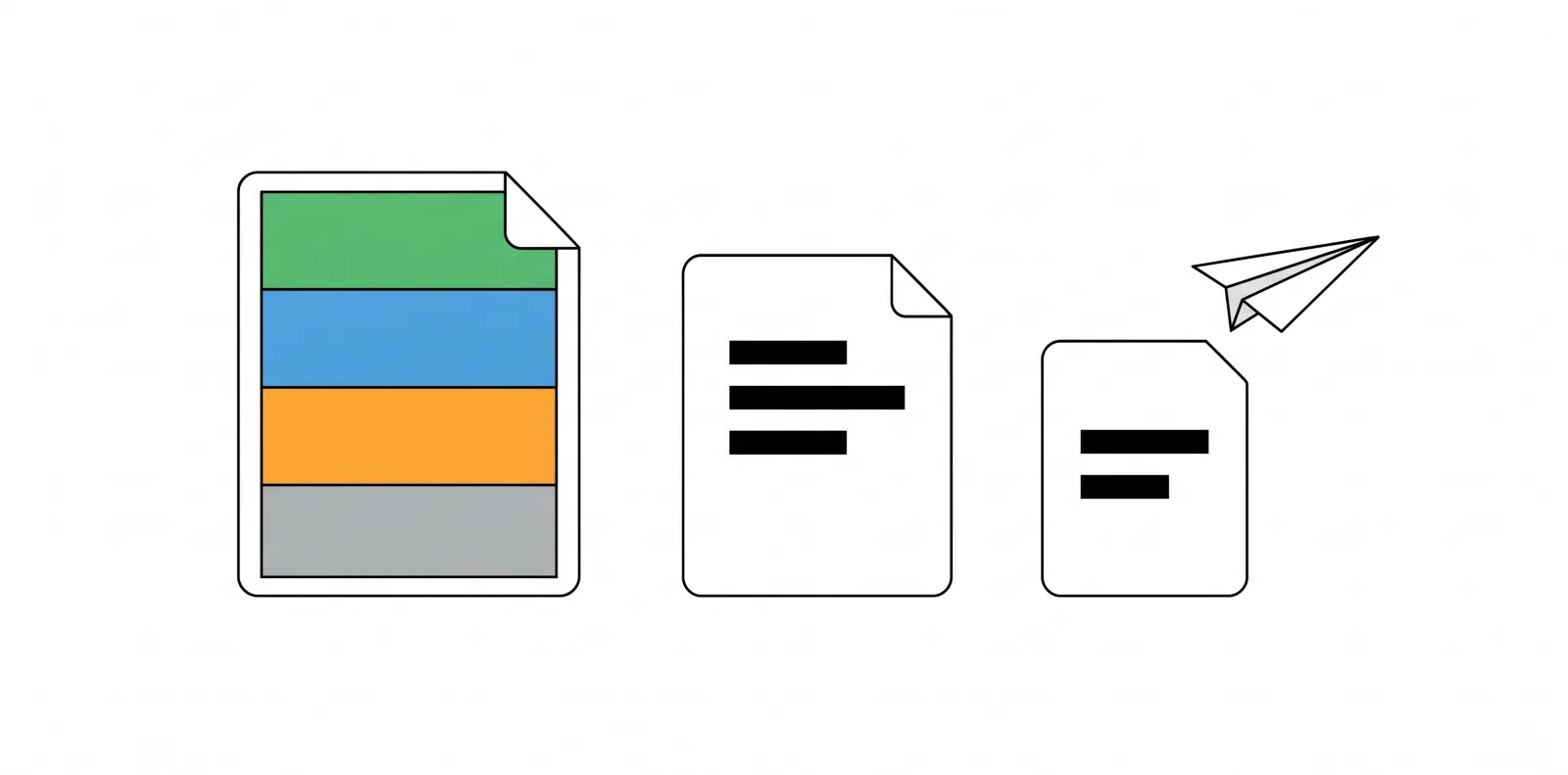
The CV establishes that you are plausible. It answers one question: does this person have the background to do this role? It is a scanned document, not a read one, which is why structure and specificity matter more than prose.
The cover letter establishes that you are interested in this role specifically. Its job is to connect something real about you to something real about them. A cover letter that restates the CV wastes the only opportunity you have to say something the CV cannot.
The cold email establishes that talking to you is worth fifteen minutes. It is not an application. It is a request for a short conversation from someone who owes you nothing, and its length and tone should reflect that.
Two terms worth defining:
Applicant tracking system. Software that stores and filters applications. Many large employers use one, which is why a CV should be a clean, conventionally structured document rather than a design exercise with text embedded in images.
Outcome statement. A description of what changed as a result of what you did, rather than a description of the task. This is the single largest difference between a weak student CV and a strong one.
The Anatomy Of A One-Page Student CV#
The ordering is the argument. Education goes at the top because for a student it is the primary qualification and the recruiter is looking for it. Projects and experience get the most space because that is where differentiation actually lives. Everything else is small.
The commonest structural errors are a photograph and personal details at the top consuming a quarter of the page, a paragraph-long objective statement that says nothing, self-rated skill bars that carry no information, and a second page that nobody reads.
On outcomes versus duties, the difference looks like this. A duty reads: responsible for managing the college technical festival's social media. An outcome reads: ran the technical festival's social media, growing the account from 400 to 2,300 followers and driving registrations for six events. Same activity, entirely different document.
The Cover Letter, In Four Short Paragraphs#
Most student cover letters are too long and too general. Four paragraphs on half a page is enough.
Paragraph one: what you are applying for and one specific reason it is this organisation. Name the role. Then say something that demonstrates you know what they actually do, which takes ten minutes of reading and is what most applicants skip. Generic enthusiasm is invisible; a specific observation is not.
Paragraph two: your single strongest relevant thing. Not a summary of your CV. One project, one internship, one result, described concretely, chosen because it maps onto this role. If nothing maps, you are applying to the wrong roles or you need a different example.
Paragraph three: the honest gap. Briefly, and without apology. A second-year applicant might note they have no commercial experience but have completed a specific certification and built a specific thing. Acknowledging the obvious gap and immediately showing what you did about it reads far better than hoping nobody notices.
Paragraph four: availability and a clear close. Your dates, your availability for a conversation, and a single sentence of thanks. No elaborate sign-off.
What to leave out entirely. Your entire academic history, which is on the CV. Any sentence beginning with a claim to be passionate. Any description of the company's greatness that they already know. And anything that reads as though it could have been sent to twenty organisations, because it will be recognised instantly.
The Cold Email, Which Is A Different Thing Entirely#
A cold email is not a shortened cover letter. It is a request to a stranger, and the entire design problem is minimising what you are asking for.
Keep it under 150 words. Anything longer will be read later, which means never.
Line one: who you are, in one sentence. Course, year, institution. No preamble.
Line two: why them, specifically. Something concrete about their work that you actually looked at. This is the line that distinguishes you from a mass mailing and it cannot be faked.
Line three: what you can offer, honestly. A relevant skill or a thing you built. One sentence. Do not oversell; a second-year student claiming expertise is less credible than one offering to be useful.
Line four: the specific ask, and make it small. Not a job. A fifteen-minute conversation, or whether they take summer interns, with your dates. A small ask is far more likely to be granted, and the conversation is where the opportunity actually appears.
Then stop. One CV attached, one page. No portfolio links stack, no certificates, no photograph.
The subject line matters more than the body, because it decides whether the body is read. Something plain and specific works best: your course, your institution and what you are asking about. Clever subject lines read as marketing.
Follow up once, after about ten days, with two sentences at the top of the original thread. Once. A second follow-up costs you the relationship and rarely produces anything.
Sending, Tracking And Following Up#
Send in volume, but not identically. Fifty cold emails with a genuinely specific second line each will outperform two hundred identical ones by a wide margin. The specificity is the whole mechanism.
Keep a simple record. Who, when, what role, what you said, whether you followed up. A spreadsheet is enough. Without it you will double-send, forget to follow up, and lose track of who replied.
Expect silence and do not interpret it. Non-reply from a busy person carries almost no information about you. Students routinely read it as rejection and stop, which is the actual reason most application campaigns fail.
Reply fast when someone does respond. Within hours if you can. Interest is perishable, and a reply three days later to someone who offered fifteen minutes frequently gets no second offer.
Use your institution's alumni network deliberately. Response rates from people who attended your college are substantially higher than from strangers, for reasons that have nothing to do with your CV. This is the most efficient channel available to a student and the least used.
And tailor the CV to the role, at least a little. Reordering your projects so the most relevant one appears first takes two minutes and changes what the eight-second scan lands on. That is the highest-return edit available to you.
Writing Outcomes When You Genuinely Have None#
The advice to write outcomes rather than duties is sound and unhelpful to a student who has never held a job. Here is how to do it anyway.
Coursework counts if you treat it seriously. A design project, a laboratory investigation or a term paper had a problem, a method and a result. Most students list the title and stop. Describe what you were trying to find out, what you did, and what you concluded, and it becomes a legitimate entry.
Competitions and hackathons count, including ones you did not win. The honest framing is what you built, in what time, with how many people, and what it did. Placing is optional information.
Positions of responsibility count if you say what changed. Being the secretary of a society is a title. Increasing attendance at society events, organising a specific number of sessions, or managing a specific budget is an outcome.
Self-directed work counts most of all, because nobody assigned it. Something you built, a dataset you analysed for your own interest, a small tool you wrote. Recruiters read unassigned work as evidence of motivation in a way that coursework never quite achieves.
Numbers help but honesty helps more. If you do not have a figure, describe the result qualitatively rather than inventing one. An invented number that collapses under one interview question costs far more than a modest claim.
And keep a running record from now on. The reason students struggle to write outcomes is not that they have none; it is that they did not write anything down at the time and cannot reconstruct the specifics a year later. A short note after every project solves this permanently.
Frequently Asked Questions#
How long should a student CV be?#
One page. A student without substantial professional experience has nothing that justifies a second page, and a second page is rarely read anyway.
Should I include a photograph on my CV?#
Generally no for applications in India and most other markets. It consumes space that should carry information, and many employers prefer applications without one.
What is the biggest mistake in student CVs?#
Describing duties instead of outcomes. Saying what you were responsible for tells a reader nothing; saying what you did and what changed as a result is what distinguishes one candidate from another.
Do I need a cover letter if it is optional?#
Usually yes, if it is short and specific to the organisation. A four-paragraph letter that shows you understood what they do is a genuine differentiator. A generic one adds nothing and costs you nothing either.
How long should a cold email be?#
Under 150 words. Who you are, why them specifically, what you offer, and a small specific ask. Anything longer gets postponed and then forgotten.
How many times should I follow up?#
Once, after roughly ten days, in two sentences on the original thread. A second follow-up is counterproductive.
Should I use a CV template with colours and graphics?#
Keep it clean and conventional. Many employers process applications through tracking software that handles unusual layouts and text-in-images poorly, and a plain, well-structured document scans faster for human readers too.
What do I put on a CV with no experience?#
Education and results, one or two projects described with outcomes, any certification with its issuing body, relevant coursework, and positions of responsibility. Nobody expects commercial experience from a second-year student, and inventing it is easily detected.