
Your Friend Scored Less Than You And Got A Better Rank. Nothing Went Wrong#
It is one of the most disorienting conversations in Indian entrance examinations. You compare answer keys, you count your marks, you feel reasonably good. Then results arrive and somebody who scored ten marks below you has a higher percentile and a better rank.
The immediate reaction is almost always suspicion. Something has gone wrong. The system is broken. Somebody has been favoured.
Almost always, nothing has gone wrong. What has happened is normalisation, and once you understand it, the result stops being mysterious and becomes obvious.
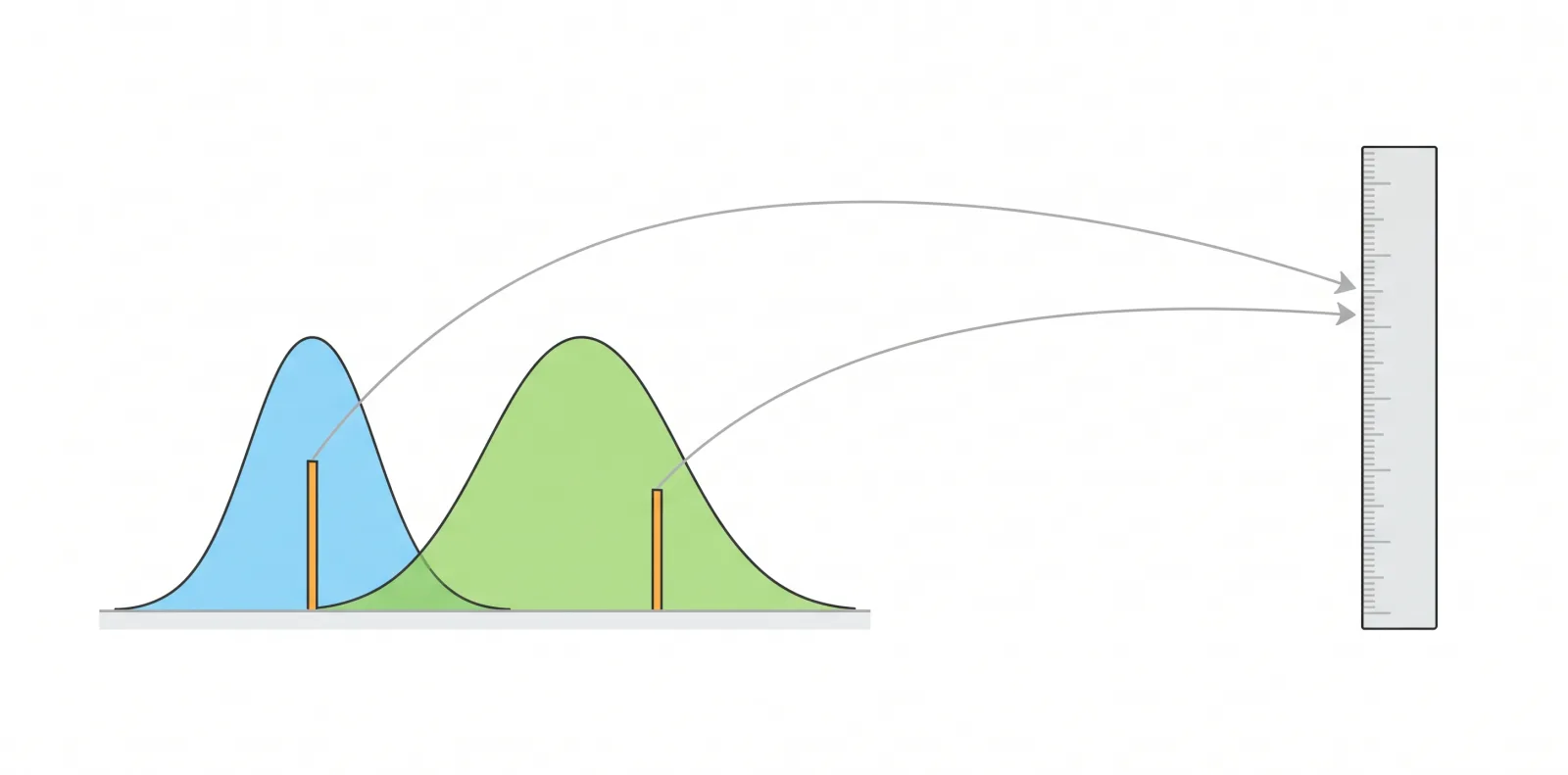
The short version: your marks are not compared with your friend's marks. Your performance is compared with the performance of everyone who sat your paper, in your shift. If your friend's shift had a harder paper, everyone in it scored lower, and their ten fewer marks represented a better performance relative to their own shift than your higher marks did relative to yours.
Let us work through exactly how that happens, with numbers.
Background: Why Normalisation Has To Exist At All#
Begin with the logistical problem, because the solution only makes sense against it.
JEE Main is sat by well over ten lakh candidates. There is no building, and no set of buildings, that can host them simultaneously. So the examination runs across multiple days, and on each day across multiple shifts, commonly a morning and an afternoon sitting.
Every shift needs a different question paper. If the same paper were used twice, candidates in the later shift would know its contents within minutes.
And here is the unavoidable consequence: it is not possible to produce many different question papers of exactly identical difficulty. Paper setters work to the same syllabus, the same blueprint and the same intended difficulty, and papers still come out slightly harder or slightly easier. That is not incompetence. It is a fact about writing examinations.
Without correction, this would mean your rank depended partly on which shift you were assigned to, which is pure luck. A strong candidate in a hard shift would be outranked by a weaker candidate in an easy one. That is the problem normalisation solves.
Some vocabulary:
Raw score. Your actual marks out of 300, computed from the marking scheme: four marks for a correct answer, minus one for a wrong one.
Percentile score. Your position relative to everyone in your session, expressed as the percentage of candidates who scored at or below you.
NTA score. The normalised score NTA publishes. It is a percentile, not a mark. This is what determines your rank.
Session. A shift, meaning the group of candidates who sat the same paper at the same time.
The Formula, Stated Plainly#
NTA uses a percentile-based method. The formula is:
Percentile score = (100 × number of candidates in the session with a raw score equal to or lower than yours) ÷ total number of candidates in that session
Four consequences follow directly from that single line, and each surprises people.
The highest scorer in every shift gets exactly 100. If you top your shift, every candidate in it scored at or below you, so the numerator equals the denominator and the fraction equals one. This is why multiple candidates score 100 percentile in a single JEE Main session. It is not an anomaly and it is not an error. With, say, ten shifts, you would expect around ten perfect percentiles per subject, and more once subject-wise percentiles are counted separately.
Percentile has nothing to do with percentage. A percentile of 95 does not mean you scored 95 per cent. It means you performed better than 95 per cent of candidates in your session. A student scoring 150 out of 300, which is 50 per cent, can comfortably exceed the 95th percentile.
Your percentile depends on who else sat your shift, not only on your own performance.
Percentiles are computed to seven decimal places. This is deliberate. With over ten lakh candidates, a percentile rounded to two decimals would produce enormous ties. Seven decimal places separates candidates who would otherwise be indistinguishable.
Worked Examples: Where Fewer Marks Wins#
Here are three candidates across two shifts. The numbers are illustrative and chosen to be easy to follow.
| Candidate A | Candidate B | Candidate C | |
|---|---|---|---|
| Shift | Shift 1, an easier paper | Shift 2, a harder paper | Shift 2, a harder paper |
| Candidates in that shift | 2,00,000 | 2,00,000 | 2,00,000 |
| Raw score out of 300 | 180 | 170 | 180 |
| Candidates scoring at or below them | 1,90,000 | 1,92,000 | 1,96,000 |
| Percentile calculation | 100 × 1,90,000 ÷ 2,00,000 | 100 × 1,92,000 ÷ 2,00,000 | 100 × 1,96,000 ÷ 2,00,000 |
| Percentile score | 95.0000000 | 96.0000000 | 98.0000000 |
Read across that table slowly, because it contains the entire point.
Candidate A and Candidate C scored identically, 180 marks each. Yet C lands at the 98th percentile and A at the 95th. Why? Because C sat the harder paper. In Shift 2, 180 marks was an unusually strong performance, beating 98 per cent of that shift. In Shift 1, where the paper was easier and everybody scored higher, the same 180 marks beat only 95 per cent.
Candidate B scored ten marks fewer than Candidate A and still finished ahead on percentile, because B's 170 in a hard shift beat more of their peers than A's 180 in an easy shift did.
This is exactly the situation that produces the "my friend scored less and ranked higher" conversation. The system is not malfunctioning. It is doing precisely what it was designed to do, which is to remove the luck of shift assignment from your result.
One important clarification. NTA does not estimate paper difficulty directly and apply a correction factor. There is no committee deciding that Shift 2 was twelve per cent harder. The adjustment is implicit: by ranking you within your own shift, a harder paper automatically produces lower raw scores across that shift, which automatically means a given score corresponds to a higher percentile. The mechanism is self-correcting rather than judgemental.
Subject-Wise Percentiles And Merging The Sessions#
Two further layers that catch students out.
Percentiles are computed separately for each subject and for the total. NTA calculates a percentile for Physics, one for Chemistry, one for Mathematics, and one for the total raw score. This is why a candidate can have a very high percentile in one subject and a middling one in another.
The important point: your overall NTA score is based on your total raw score percentile, not on an average of your three subject percentiles. Those are different numbers and averaging the subject percentiles yourself will give you a figure that does not match your result.
Sessions are merged. With JEE Main running in January and April, NTA compiles results across both. A candidate who sat both sessions has the better of the two NTA scores taken forward. This is worth understanding as strategy: a poor January attempt cannot damage a good April one, which removes a common source of anxiety about whether to sit the first session.
Tie-breaking. When candidates end up with identical NTA scores, a published sequence of tie-breakers applies, typically involving subject-wise percentiles in a specified order and, in some formulations, age or application number as a final resort. The exact sequence is stated in each year's information bulletin and has changed between cycles, so read the current one rather than assuming.
The Criticisms, Taken Seriously#
A balanced account owes you the objections, because they are not frivolous and students and academics have raised them consistently.
The assumption of comparable cohorts. Percentile normalisation rests on the premise that candidates are distributed randomly across shifts, so that each shift contains a comparable spread of ability. With very large numbers this is statistically reasonable. Critics argue that shift allocation is not perfectly random in practice, since it interacts with city, centre and application timing, and that a shift containing a slightly stronger cohort would depress percentiles for everyone in it regardless of paper difficulty.
It corrects for the shift, not for the individual. If a particular shift's paper was unusually hard in one subject only, normalisation handles the aggregate effect but not the specific disadvantage to a candidate whose strength happened to be in that subject.
It is hard to verify from outside. NTA publishes the formula but not the underlying shift-wise score distributions. Candidates therefore cannot independently reproduce their own percentile, which is a reasonable transparency criticism even if the method itself is sound.
The counter-argument, which is also strong. Every alternative is worse. A single shift for everyone is logistically impossible. Using raw marks across different papers would make the shift lottery decisive rather than incidental. More elaborate item-response models would be less transparent and harder to explain than a formula that fits on one line. Percentile normalisation is a defensible compromise: simple, published, and robust at large sample sizes.
What this means for you in practice. You cannot influence which shift you get, and you cannot influence the paper's difficulty. What you can influence is your performance relative to everyone else sitting the same paper. So the only rational response to normalisation is to stop thinking in marks and start thinking in relative performance. Do not walk out of a hard paper assuming disaster. If it was hard for you, it was hard for everyone in your shift, and your percentile reflects the comparison, not the absolute.
What To Do With This Understanding#
Five practical consequences.
Stop predicting your rank from raw marks. Marks-versus-rank tables circulated after every session are estimates built on previous years and averaged across shifts. They can be wrong by a substantial margin, particularly in a year where paper difficulty shifted.
Do not panic after a hard paper. The instinct to write off an attempt because the paper felt brutal is exactly backwards. A hard paper lowers everybody's raw score and leaves your relative position intact.
Sit both sessions if you are prepared for both. The better score counts, so a weak first attempt costs you nothing on paper. It can cost you confidence, which is a genuine consideration, so decide on preparedness rather than on the fact that the attempt exists.
Accuracy matters more than volume. Because you are competing on relative position, and because a wrong answer costs a mark under the current scheme which now extends negative marking to numerical questions as well, careless errors are expensive. Two avoidable mistakes can move you several thousand ranks in a cohort this size.
And read the current bulletin for the details. The formula has been stable, but tie-breaking rules and marking details have changed between cycles. The authoritative source is NTA's own information bulletin at jeemain.nta.ac.in, not a coaching summary or a forwarded screenshot.
Frequently Asked Questions#
What exactly is normalisation in JEE Main?#
A statistical method that converts your raw marks into a percentile reflecting your standing within your own shift, so that candidates are neither helped nor harmed by the difficulty of the particular paper they happened to receive.
What is the percentile formula?#
Percentile score equals 100 multiplied by the number of candidates in your session scoring at or below you, divided by the total number of candidates in that session. It is computed to seven decimal places to reduce ties.
Why did multiple students get 100 percentile?#
Because the top scorer in every shift receives exactly 100 by construction. With many shifts, and with separate percentiles computed for each subject and for the total, multiple perfect percentiles are expected rather than anomalous.
Is percentile the same as percentage?#
No. Percentile is your position relative to other candidates in your session. Percentage is your share of the total marks. A candidate scoring half the available marks can comfortably exceed the 95th percentile.
Can someone with fewer marks get a higher percentile than me?#
Yes, if they sat a harder shift where their score represented a better relative performance. This is the intended behaviour of the system, not a fault in it.
Is my overall score the average of my three subject percentiles?#
No. Your overall NTA score is the percentile of your total raw score, computed separately. Averaging your subject percentiles will produce a different and incorrect figure.
If I sit both sessions, which score counts?#
The better of the two. A weaker attempt in one session does not pull down a stronger one in the other.
Is normalisation fair?#
It is a defensible method with genuine limitations. It assumes comparable ability distributions across shifts, it corrects at the shift level rather than the individual level, and candidates cannot independently verify their own percentile because shift-wise distributions are not published. Every practical alternative, however, has larger problems.