
Three Examinations, One Spring, And A Solution That Is Not "Try Harder"#
By January of Class 12, a particular kind of student has emerged. They are up at five, studying until one in the morning, running on four or five hours of sleep and a great deal of tea. They have not seen a friend socially since September. They feel permanently behind, and the advice they keep receiving is some version of push harder.
That advice is not merely unhelpful. It is arithmetically wrong, and it misdiagnoses the problem.
The problem is not effort. Students in this position are already working near the maximum sustainable number of hours. The problem is that three examinations are being treated as three separate projects, when they are substantially one project with three different output formats. And the hours being added at the margin are being taken from sleep, which is where the day's learning actually gets consolidated into memory.
A student sleeping five hours and studying fourteen is not outperforming a student sleeping seven and studying eleven. The evidence on memory consolidation points firmly the other way, and the second student is also considerably more likely to still be functioning in March.
Here is a structure that holds.
Background: How Much These Three Examinations Actually Share#
Work out the overlap first, because it determines how much work there genuinely is.
CBSE Class 12 boards test a defined syllabus through written papers with stepwise marking. Partial credit exists. Presentation and method matter.
JEE Main tests the same physics, chemistry and mathematics content, drawn from the same NCERT-aligned syllabus, through multiple choice and numerical questions with negative marking. No partial credit. Speed matters. Since 2026, Section B is fully compulsory and negative marking extends to numerical questions, which means you cannot route around your weakest chapters and you cannot guess freely.
CUET UG tests domain subjects whose syllabi are built on the same NCERT foundation, plus a language paper and a General Aptitude Test covering general knowledge and current affairs, numerical ability and reasoning.
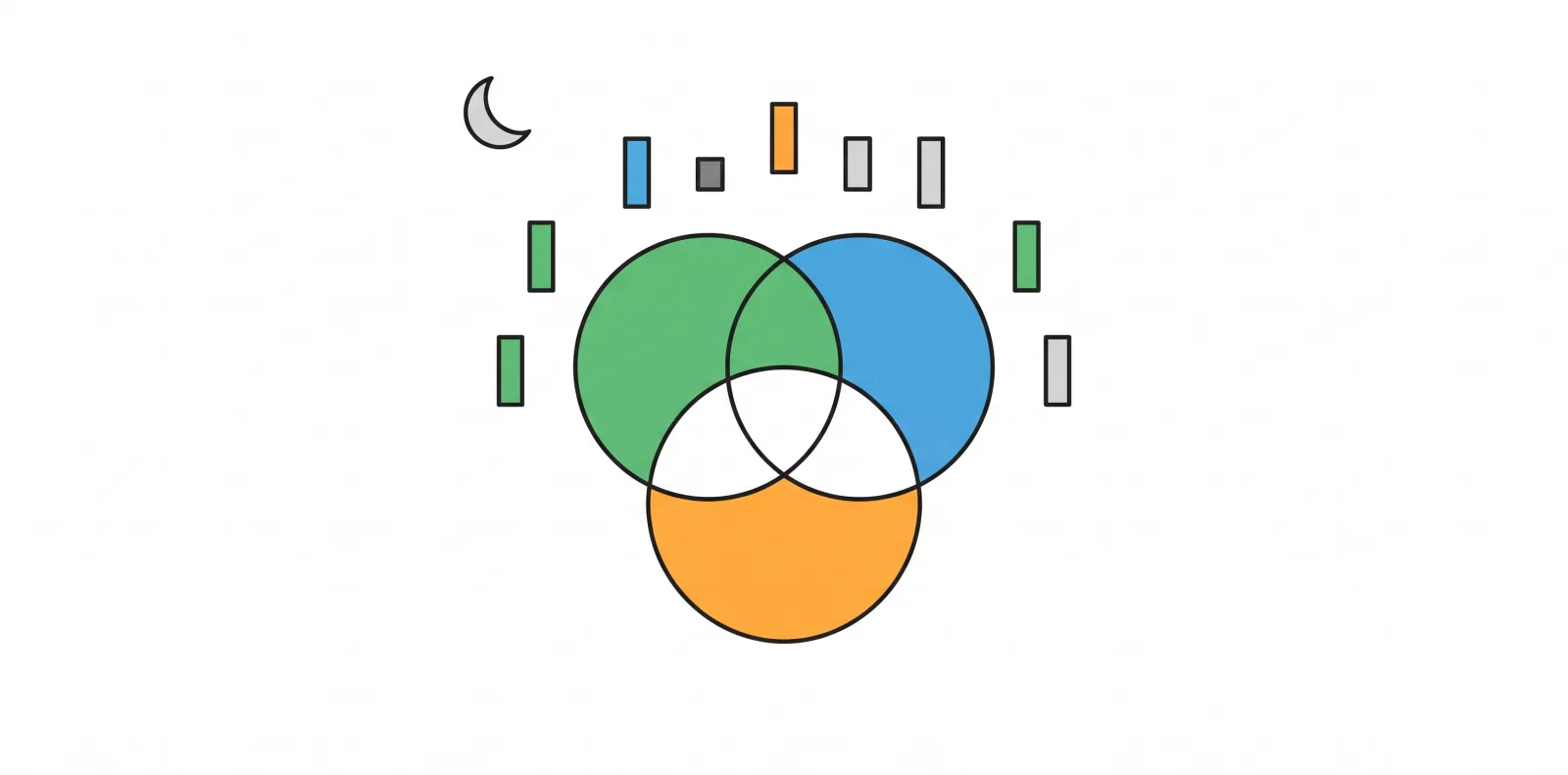
So the content overlap is very large. Perhaps seventy per cent of your subject learning serves all three. What differs is the output format: writing a full derivation with steps, solving a multiple choice question in ninety seconds, and answering a comprehension passage under time.
And the genuinely additional work is small and specific. For CUET, it is the language paper and the General Aptitude Test, neither of which overlaps with anything else. That is the real extra load, and it is far smaller than students assume.
Two terms for later:
Mock cadence. How frequently you take full-length practice papers, and how that frequency changes across the year. Too few and you never build examination stamina. Too many and you spend the year measuring rather than improving.
Sleep debt. The accumulated shortfall between the sleep you need and the sleep you get. It does not disappear when you have a good night. It compounds, and it degrades attention, working memory and mood measurably.
A Weekly Structure That Survives Contact With Reality#
The template below assumes school or coaching occupies part of the day. Adjust the absolute hours to your own situation, but keep the proportions and keep the rest day.
| Slot | Weekdays | Weekend | Why it is structured this way |
|---|---|---|---|
| Sleep | Seven to eight hours, at consistent times | Same, without a large lie-in | Memory consolidation happens during sleep. A consistent schedule matters as much as the total, because an irregular one produces the same impairment as a short one |
| Morning block, roughly 2 hours | Problem solving in your hardest subject | Full-length mock, at the same time of day as your real examination | Your most demanding cognitive work belongs in your sharpest hours, not at midnight |
| School or coaching | As scheduled | Rest day for one weekend day | Non-negotiable structure. Treat contact hours as study rather than as an interruption to it |
| Afternoon block, roughly 2 hours | Revision and consolidation of the day's material | Mock analysis, error log update | Revising on the same day you learn something is worth several times the same effort a week later |
| Evening block, roughly 2 hours | Rotating: board-format written answers, entrance-format questions, CUET aptitude practice | Light revision only | The rotation is what keeps all three formats alive simultaneously |
| Daily minimum, 30 minutes | Whichever of the three you are not prioritising this month | Same | Thirty minutes keeps a skill from decaying. This is the single most useful habit in the whole plan |
| Exercise, 30 minutes | Walk, sport, anything that raises your heart rate | Same | Good evidence for mood regulation and sleep quality. It is the first thing students drop and among the least wise to drop |
| Rest day | None on weekdays | One full day per week, genuinely off | Performance declines measurably without recovery. A guilty half-study day provides neither rest nor work |
The daily minimum row is the one that solves the balancing problem. During board-focused weeks, thirty to forty-five minutes of multiple choice practice keeps your entrance reflexes intact. During entrance-focused weeks, two full written answers a week keep your board writing speed and structure alive. Without it, you spend the first week of each transition relearning a format you already knew.
Mock Test Cadence: Building Without Grinding#
The most common mistake is taking too many mocks too early and analysing none of them.
Early in the year, roughly April to September. One full-length mock a month is sufficient. Its purpose is calibration, not improvement, and you should expect the early ones to be discouraging. That is the point. The hours in this period belong to learning content.
Middle of the year, roughly October to December. One every fortnight, rising to weekly by December. Now you are building stamina and diagnosing patterns.
Board season, roughly February to March. Board papers become the priority. Maintain one entrance-format paper a week, no more, purely to keep the format familiar.
After boards, roughly late March to May. Daily or near-daily in the final fortnight before your entrance examination. This is the peak and it should be short.
And the rule that matters more than the frequency: analyse every mock within twenty-four hours, or do not take it. An unanalysed mock is an afternoon spent measuring rather than improving.
The analysis has exactly four categories, and each demands a different response. Concept not known requires going back and relearning. Concept known, calculation slipped requires timed practice, not relearning. Question misread requires slowing down on the first read, which is counterintuitive and effective. Ran out of time requires pacing work and a better attempt order.
Most students find their errors cluster in one or two categories. Once you know your pattern, you can check for it specifically in the last few minutes of the real examination.
CUET Without Adding A Third Full Workload#
CUET is where students either lose marks unnecessarily or waste time preparing material they already know.
Your domain papers need almost no separate preparation. They follow the same NCERT-based content you are already studying for boards and JEE. The additional work is format familiarity, which a handful of practice papers provides.
The General Aptitude Test is the efficient place to gain. It covers general knowledge and current affairs, numerical ability, quantitative reasoning and logical reasoning. Almost nobody prepares for it, because it looks like something you either have or do not. That is precisely why a modest effort produces a disproportionate percentile gain.
Fifteen minutes of newspaper reading daily, kept in one notebook, handles current affairs far better than forty hours of cramming in April, because this material is absorbed rather than memorised. Twenty numerical and reasoning questions a day for three months transforms that section, because reasoning question types are learnable patterns rather than knowledge.
The language paper rewards active practice. It is mostly comprehension. Practise by reading a passage, answering, and then going back to locate the exact line justifying each answer. That verification habit is what lifts accuracy.
Choose your subjects by working backwards. List the course and university combinations you would accept, open each admission bulletin, and note the exact subject requirements. Choose the combination covering the most of them. Students lose access to courses they wanted because of a subject choice made months earlier by instinct.
Total additional load: perhaps three to four hours a week. Not a third full preparation.
Burnout: What It Actually Looks Like, And What To Do#
This needs specifics rather than generalities, because burnout is recognisable before it becomes a crisis.
Measurable early signs. Your mock scores plateau or decline despite unchanged effort. You read the same page repeatedly without retaining it. Tasks that took an hour now take two. You feel tired after sleeping. You have stopped doing things you used to enjoy, including talking to friends. Small setbacks produce disproportionate reactions.
The trap. Every one of those signs makes students study more, because the natural interpretation is that they are falling behind. More hours on a depleted system produces less learning and deeper depletion. This is the loop that consumes a year.
What actually works. Reduce the load for three or four days rather than pushing through. Restore sleep to seven or eight hours and keep it consistent. Reintroduce physical activity. Talk to somebody, which helps more than students expect. Then return at a sustainable level rather than attempting to make up the lost days.
More serious signs. Persistent hopelessness about the outcome, withdrawal from everyone, inability to sleep even when exhausted, or thoughts of self-harm. These need support rather than a schedule adjustment.
Where to get help. India's national mental health helpline, Tele-MANAS, is free and available around the clock on 14416 or 1-800-891-4416, in English and twenty regional languages. It was launched by the Ministry of Health and Family Welfare and offers counselling, psychiatric consultation and referral. There is no threshold of severity you need to reach before calling, and you do not need a diagnosis to talk to somebody.
A note for families. The pressure around this year is often transmitted rather than generated. Asking a student daily how their preparation is going, comparing them to relatives, or attaching the family's expectations to a single result adds load without adding capacity. The most useful thing a family can do is protect the student's sleep, feed them properly, and make it clear that the relationship does not depend on a rank.
The Perspective Worth Keeping#
Two things are true at once, and holding both is the healthiest position available.
This year matters. The outcome affects which institutions you can attend and what the next few years look like. Working seriously is rational.
And it is one year of a long life, with more routes through it than the conversation around you admits. State engineering colleges, private institutions, BITSAT, CUET-route universities, AYUSH and allied health courses, research paths, and reattempts all exist. People change fields at twenty-five and thirty and do well. The idea that a single spring determines everything is not supported by how careers actually unfold, and believing it is both inaccurate and, in this context, genuinely dangerous.
Work hard, sleep properly, keep one day a week, and keep the outcome in proportion. That combination produces better results than the alternative, which is the useful thing about it: the sustainable approach is also the higher-scoring one.
Frequently Asked Questions#
How much do boards, JEE and CUET actually overlap?#
Substantially. All three draw on the same NCERT-based subject content, so perhaps seventy per cent of your learning serves all three. What differs is the output format: stepwise written answers, timed multiple choice, and comprehension-based aptitude questions.
How many hours a day should I study?#
Around six to eight focused hours on weekdays, more at weekends, is realistic and sustainable for most students. Focused is the operative word, and cutting sleep to add hours reduces retention rather than increasing it.
Is it really necessary to take a full day off each week?#
Yes. Performance declines measurably without recovery, and students who never stop are the ones who collapse in February. A guilty half-study day is the worst of both options, so make it a real day off.
How many mock tests should I take?#
Build gradually: monthly early in the year, fortnightly by autumn, weekly by December, one a week during board season, and daily in the final fortnight before your entrance examination. Analyse every single one within twenty-four hours.
How much extra time does CUET need?#
Around three to four hours a week. The domain papers overlap almost entirely with your existing preparation. The genuinely additional work is the language paper and the General Aptitude Test, which is also the most efficient place to gain a percentile advantage.
What should I do during the gaps between board papers?#
Revise only for the next paper. Solve one previous year paper of that subject, review the marking scheme, revise formulae the evening before, and sleep normally. Do not start new topics and do not discuss the paper you have just written.
How do I know if I am burning out rather than just tired?#
Look for measurable signs: mock scores plateauing or falling despite unchanged effort, rereading without retention, tasks taking longer, waking unrefreshed, withdrawal from people, and disproportionate reactions to small setbacks. Studying more at that point makes it worse.
Where can I get help if the year becomes unmanageable?#
Tele-MANAS, India's national mental health helpline, is free and available around the clock on 14416 or 1-800-891-4416 in English and twenty regional languages. Tell a family member or teacher as well. Reduce the load rather than pushing through, because performance falls with sustained distress.