Your Bank Is Not The Only Lender In The Room#
A student in Kolkata can borrow ten lakh rupees for higher education at four percent simple interest, without collateral, without a guarantor, and without an income ceiling.
A student in Patna can now borrow four lakh rupees at no interest at all.
Meanwhile, students in both cities queue at bank counters for loans priced somewhere between eight and a half and thirteen percent, because nobody told them the state was also lending.
State education loan schemes are the most consistently missed funding source in Indian higher education. They are missed because they are administered by state higher education departments rather than banks, publicised through state portals rather than branch networks, and entirely absent from the conversation a family has when they walk into a bank to ask about a loan.
The schemes are real, the rates are genuinely better, and the eligibility conditions are narrower than a bank's but not unreasonably so. What follows is what the major ones actually offer, how they are structured, and how to find yours.
One caution before the detail. State schemes change with budgets and with governments, sometimes substantially. Every figure below should be confirmed on the relevant state portal before you plan around it.
Background: Two Ways A State Can Help You Borrow#
Almost every state scheme uses one of two designs, and the distinction determines everything about how you apply.
Design one: the state lends, or guarantees. The state itself, or a state corporation, provides the loan, or the state stands as guarantor to a bank so that collateral and guarantor requirements fall away. West Bengal's Student Credit Card and Bihar's Student Credit Card both work this way. The rate is set by the state, which is why it can be far below anything commercial lending produces.
Design two: the state subsidises interest on an ordinary bank loan. You take a normal education loan from a bank, and the state pays some or all of the interest. Odisha's Kalinga Sikhya Sathi Yojana works this way. The loan is a bank loan with bank documentation, but the effective cost to you is a fraction of the headline rate.
Why the distinction matters practically. Under design one, you start at a state office. Under design two, you start at a bank and the state subsidy is claimed alongside. Families frequently approach the wrong counter first and conclude the scheme does not exist.
Two terms worth defining:
Simple interest. Interest charged only on the principal, not on accumulated interest. Over a long tenure this is dramatically cheaper than the compounding that ordinary loans use.
Interest subvention. A subsidy in which a government pays part of your interest directly to the lender. You never see the money; you simply owe less.
What The Major Schemes Actually Offer#
| Scheme | Amount | Cost to you | Key conditions |
|---|---|---|---|
| West Bengal Student Credit Card | Up to ₹10 lakh | 4% simple interest. Additional 0.5% concession for girl students; 1% concession for servicing interest during study | Indian national, resident of West Bengal for at least 10 years. No collateral, no guarantor, no income limit. Repayment up to 15 years including moratorium. Covers study in India and abroad, with up to 30% usable for non-institutional expenses |
| Bihar Student Credit Card (MNSSBY) | Up to ₹4 lakh | Interest-free since the September 2025 revision, replacing the earlier 4% general and 1% concessional rates | Bihar domicile, applied through a District Registration cum Counselling Centre. State acts as guarantor. Repayment extended to 7 years for loans up to ₹2 lakh and 10 years above that |
| Odisha Kalinga Sikhya Sathi Yojana | Up to ₹10 lakh | Student bears 1%; the state subsidises the remaining interest | Family income ₹6 lakh or below. Repayment up to 10 years for loans to ₹7.5 lakh and 15 years to ₹10 lakh. Structured as an interest subvention on a bank loan |
| Karnataka Arivu (KMDC) | Up to ₹5 lakh per year for MBBS, MD and MS; lower bands for other professional courses | Heavily concessional, with a nominal service charge | Karnataka resident from a notified minority community, family income ₹8 lakh or below, seat obtained through KEA counselling under the government quota for specified professional courses |
| Ambedkar Overseas Vidya Nidhi (Telangana and Andhra Pradesh) | Up to ₹20 lakh | A grant, not a loan. Nothing to repay | SC and ST students, postgraduate or doctoral study abroad, minimum 60% in the qualifying examination, family income ₹5 lakh or below, age limit 35, one beneficiary per family. Selection considers GRE, GMAT, TOEFL or IELTS performance |
Look at the West Bengal row once more. Ten lakh, no collateral, no guarantor, no income ceiling, four percent simple interest, fifteen years to repay. Compared against a commercial education loan at nine or ten percent compounding, the difference across the life of the loan runs to several lakh rupees. For a student with West Bengal domicile, checking this before signing a bank sanction letter is not optional diligence; it is the single largest financial decision available to them.
And note what Bihar's revision did. Moving from four percent to zero, and extending tenures by two to three years, converts a modest concessional loan into something closer to a grant with an obligation attached. The amount is smaller than West Bengal's, which suits it to study within India rather than abroad.
Other states run schemes too. Tamil Nadu, Kerala, Maharashtra, Gujarat, Rajasthan, Assam and several others operate education loan support, interest subvention or corporation-run lending, typically routed through community development corporations or minority welfare departments. Their terms vary too widely to tabulate reliably and change frequently. The section on finding yours, below, explains how to locate them.
What The Eligibility Conditions Are Really Screening For#
Read across the table and the conditions cluster into four categories. Understanding what each is doing helps you judge quickly whether you qualify.
Domicile. Every scheme requires it, and several specify a minimum residence period, such as West Bengal's ten years. This is the hardest condition to work around because it is documentary and binary. Domicile certificates take time to obtain, which is the practical reason to start early rather than at the point of admission.
Income ceiling. Present in most schemes, at levels between five and eight lakh rupees of annual family income. West Bengal is the notable exception, imposing none. Where a ceiling exists, the income certificate is the document most likely to delay an application, because it comes from a revenue authority rather than from you.
Category. Several schemes are targeted at scheduled castes, scheduled tribes, other backward classes or notified minority communities, and are administered by the corresponding development corporation. This is not a reason to skip the search if you do not belong to a targeted category, because the general schemes, such as those in West Bengal, Bihar and Odisha, are open to all.
Admission route and course. Karnataka's Arivu is the clearest example, requiring a seat obtained through state counselling under the government quota for specified professional courses. Management quota admissions are commonly excluded from state schemes, exactly as they are from the central PM Vidyalaxmi scheme. If you are considering a management seat, assume state support will not follow it.

Where State Schemes Beat A Bank, And Where They Do Not#
State schemes are not strictly superior, and it is worth being clear about the trade-offs before you reorganise a plan around one.
Where they clearly win. On price, comprehensively and by a wide margin. On security, since several dispense with collateral and guarantor requirements at amounts where a bank would insist on both. And on tenure, with fifteen-year repayment periods that produce instalments a graduate can actually absorb.
Where they are weaker. On amount, mostly. Ten lakh covers a professional degree in India comfortably and a master's abroad barely; four lakh does neither of the latter. On speed, since state processes route through district offices and departmental approvals that are rarely fast. And on certainty, since schemes are subject to budgetary allocation and administrative capacity in a way that a bank's product is not.
On coverage. Note that West Bengal's scheme explicitly extends to study outside India, which many people assume state schemes do not. Others are India-only. Check rather than assume.
The sensible approach is to combine them. For a student whose total requirement exceeds the state ceiling, the state scheme covers the first tranche at its very low rate and a bank loan covers the balance. This is administratively more work than a single loan, and it is frequently worth several lakh rupees.
One important sequencing point. Apply to the state scheme first, or at least in parallel. A bank sanction already drawn complicates a subsequent state application, and in some cases disqualifies the same expenditure from being funded twice. Sort out the cheap money before you commit to the expensive money.
Finding And Applying For Yours#
Start with your state's higher education department website, not with a search for education loans generally. The schemes live there, and the commercial search results are dominated by loan aggregators who do not benefit from telling you about a four percent state scheme.
Also check three other departments, because state schemes are scattered: the social welfare or scheduled caste and scheduled tribe development department, the minority welfare department, and the backward classes welfare corporation. Each frequently runs its own lending or subsidy scheme with its own portal.
Check the national scheme aggregator. The central government's scheme portal indexes many state programmes with eligibility filters, which is a faster way to find what applies to you than reading five departmental websites.
Assemble the documents before the deadline, not after finding the scheme. Domicile certificate, income certificate, caste certificate where relevant, admission letter, fee structure from the institution, academic records, and bank account details. The two certificates from revenue authorities are the ones that take weeks, so start them early.
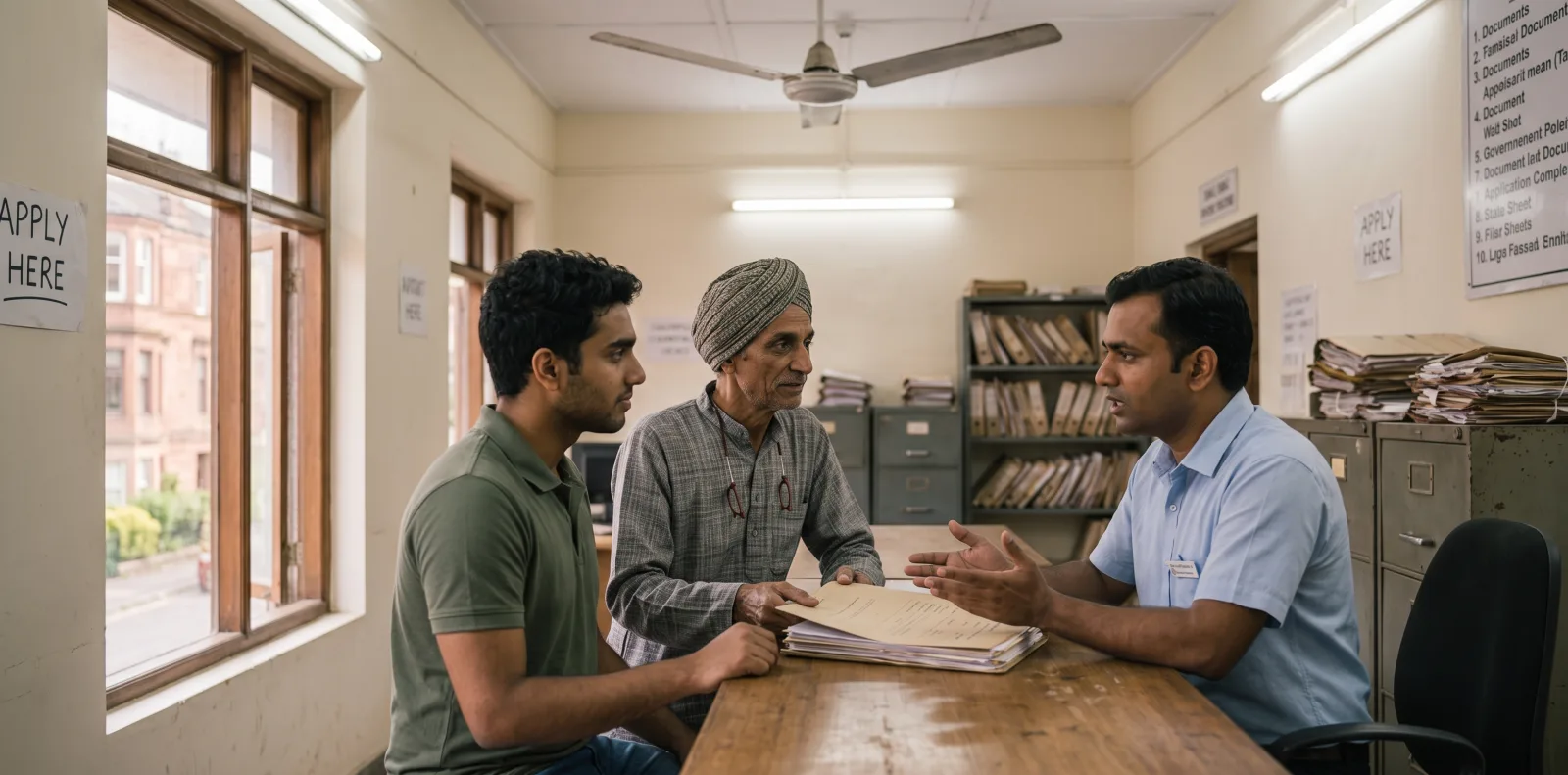
Expect to visit an office. Bihar routes applications through District Registration cum Counselling Centres. Most state schemes have a physical verification step. Budget the time rather than assuming an online submission finishes the job.
Ask the institution's scholarship or financial aid cell. Colleges that admit large numbers of students from a particular state generally know which schemes their students use, and can tell you in five minutes what a week of searching would.
And confirm every figure at source. This article's numbers reflect scheme terms as documented at the time of writing. Rates, ceilings and tenures are revised, sometimes in the direction Bihar moved in 2025 and sometimes the other way.
When The Terms Change, And How To Stay Current#
State schemes move more than central ones, and a figure that was accurate last year may not be accurate when you apply.
They move with budgets. Allocations are set annually, and a scheme that is generously funded in one year can be constrained in the next. Where allocation runs out, applications are not rejected so much as delayed, which is worse for a student with a fee deadline.
They move with governments. Bihar's shift to interest-free lending in September 2025 is the clearest recent example, and it moved decisively in the students' favour. Changes can run the other way too, tightening income ceilings or narrowing course coverage.
They move quietly. Revisions are published in departmental notifications and gazette entries rather than announced to applicants. The aggregator sites that dominate search results update slowly and inconsistently, which is why several of them still quote Bihar's superseded four percent rate.
Three habits keep you current. Check the official state portal rather than a third-party summary, note the date on whatever page you are reading, and telephone or visit the district office to confirm before you plan around a figure. A ten minute call is cheaper than a plan built on last year's terms.
And apply in the same academic cycle as your admission. Most schemes are structured around a current admission, and applying a year late generally means applying for nothing.
Frequently Asked Questions#
Which state offers the best education loan terms?#
On headline terms, West Bengal's Student Credit Card is exceptional: ten lakh rupees at four percent simple interest, collateral-free, guarantor-free, with no income ceiling and fifteen years to repay. Bihar's scheme is cheaper still at zero interest but capped at four lakh.
Is the Bihar Student Credit Card really interest-free?#
The September 2025 revision made loans under the scheme interest-free, replacing the earlier structure of four percent for general applicants and one percent for women, differently abled and transgender students. Repayment tenures were extended at the same time. Confirm current terms at your District Registration cum Counselling Centre.
Do I need collateral for a state scheme?#
Generally no. West Bengal's scheme requires neither collateral nor a guarantor at ten lakh, and Bihar's has the state acting as guarantor. This is one of the strongest arguments for checking a state scheme before approaching a bank.
Can I use a state scheme for study abroad?#
Sometimes. West Bengal's scheme explicitly covers institutions outside India. Several others are restricted to domestic study. The overseas grant schemes in Telangana and Andhra Pradesh are specifically for foreign postgraduate and doctoral study. Check the individual scheme.
What if my requirement exceeds the state ceiling?#
Combine. Take the state scheme up to its ceiling at its low rate and a bank loan for the balance. Apply to the state scheme first, since an existing bank sanction can complicate or disqualify a later state application for the same expenditure.
Are these schemes only for particular communities?#
No. Some are, and are run by minority or scheduled caste and tribe development corporations. But the general schemes in West Bengal, Bihar and Odisha are open to all domiciled students meeting the stated conditions.
Will a management quota admission qualify?#
Usually not. State schemes commonly exclude management quota seats, as does the central PM Vidyalaxmi scheme. Karnataka's Arivu requires the seat to have come through state counselling under the government quota.
How long does the process take?#
Longer than a bank. Expect weeks rather than days, driven mainly by the domicile and income certificates and by a physical verification step at a district office. Start well before your fee deadline rather than after it.