
The Sentence That Costs Families The Most Money#
"Repayment starts after your course finishes."
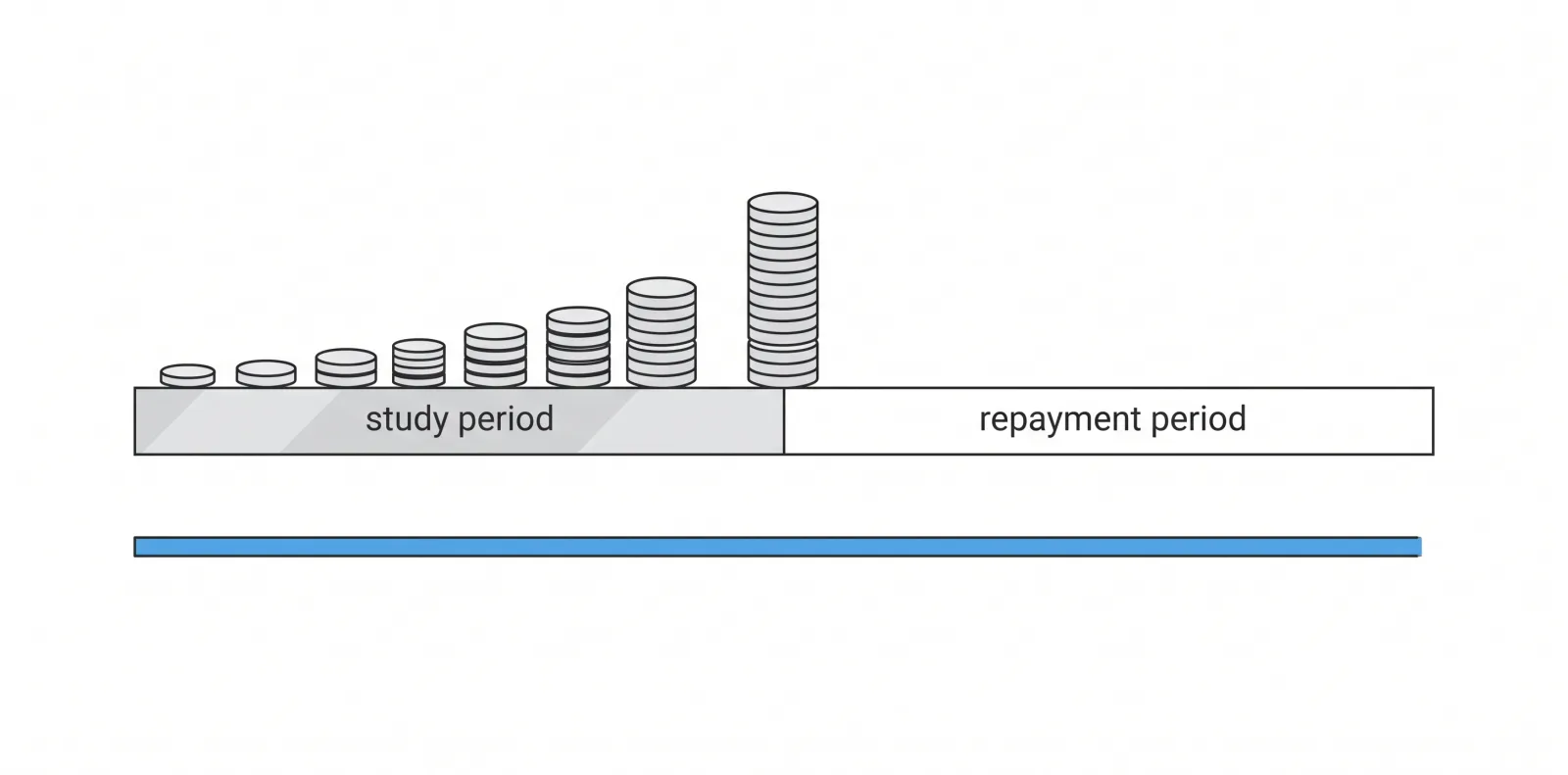
It is true, and it is incomplete in a way that misleads almost every borrower. Repayment of principal is deferred. Interest is not. Your loan begins accruing interest from the day the first amount is disbursed, which for most students is several years before they earn anything.
What happens to that interest during your course determines a very large part of what the loan eventually costs you, and most borrowers never make an active decision about it. They simply let it accumulate, because nobody explained that there was a choice.
There is a choice, it is straightforward, and taking it is among the highest-return financial decisions available to a student. Here is how the mechanics actually work.
Background: The Three Periods Of An Education Loan#
The disbursement period. Money is released, usually semester by semester rather than as a lump sum, directly to your institution for fees and sometimes to you for other costs. Interest begins on each tranche from the date it is released.
The moratorium. Also called the repayment holiday. Covers your course duration plus a further period afterwards, commonly six months to a year, intended to give you time to find employment. Principal repayment is deferred throughout. Interest continues to accrue.
The repayment period. Equated monthly instalments begin, running for a tenure that can extend to fifteen years depending on the loan.
Two terms that decide everything:
Simple interest during moratorium. The interest accruing on the outstanding balance, calculated on the principal alone.
Capitalisation. If you do not pay the interest as it accrues, it is added to your principal at the end of the moratorium. Your repayment then begins on a larger principal, and that larger principal attracts interest for the entire repayment period. This is the mechanism that quietly inflates education loan costs.
What Capitalisation Actually Does#
The decision that follows. If you can pay the interest as it accrues during your course, even partially, do. A student with a part-time income, or a family able to contribute a modest monthly amount, avoids capitalisation on that portion.
And ask about the concession. Many lenders offer a reduction in the interest rate, commonly cited around one percentage point, for borrowers who service interest during the moratorium. That concession applies to the whole loan, which means paying interest during study delivers two benefits at once: no capitalisation, and a lower rate thereafter.
The amounts involved are small monthly and large cumulatively. On a loan disbursed progressively, early-year interest is modest because the outstanding balance is small. A student who starts servicing interest from the first year pays very little in that year and avoids years of compounding.
How Your Instalment Is Structured#
Equated monthly instalments are level in amount and shifting in composition. Early instalments are mostly interest with a small principal component. Later instalments reverse this.
Which has two consequences. Your outstanding principal falls slowly at first, and prepayment early in the tenure is far more valuable than prepayment late, because it removes interest that would otherwise accrue across the remaining years.
Tenure and instalment trade against each other. A longer tenure gives a smaller monthly instalment and a larger total cost. A shorter tenure does the reverse. The right answer depends on what your expected income can comfortably service, and the test is whether the instalment remains manageable at a rate two percentage points above your quoted one, since most education loan rates float.
Prepayment, Which Is Under-Used#
Education loans generally permit prepayment without penalty. This is a genuine feature and it distinguishes them from some other retail lending. Confirm it for your specific loan, but it is the common position.
Which makes prepayment the strongest tool a borrower has. Any surplus applied to the principal reduces the interest accruing across every remaining month.
Two ways to prepay, with different effects. Reducing the tenure while keeping the instalment the same saves the most interest. Reducing the instalment while keeping the tenure gives you monthly breathing room and saves less. Lenders sometimes default to the second; specify which you want.
When to prepay. A bonus, an increment, a maturing deposit. Early in the tenure, when the interest component of each instalment is highest, the effect is largest.
One caveat worth naming. Prepaying reduces the interest you pay, which reduces the Section 80E deduction you can claim on it. This is a partial offset rather than a reason to keep the debt: paying less interest beats deducting more of it. Do not let a tax deduction persuade you to carry a loan longer than necessary.
And keep some liquidity. Prepaying your entire emergency fund into a loan leaves you borrowing expensively the next time something goes wrong. Prepay surplus, not reserves.
Servicing Interest During Study: The Cheapest Decision Available#
If this article achieves one thing, let it be this. Servicing interest during the moratorium is the highest-return financial decision available to most education loan borrowers, and most of them never consider it.
What it means in practice. During your course and the grace period afterwards, interest accrues on whatever has been disbursed. The default arrangement is that this interest is added to your principal. The alternative is that you pay it monthly as it arises, in amounts far smaller than a full instalment.
The first effect is that your principal does not grow. A loan of fifteen lakh that accrues interest untouched for four years enters repayment at substantially more than fifteen lakh, and every subsequent year of interest is charged on that larger figure. Servicing the interest means the loan you repay is the loan you borrowed.
The second effect is a rate concession. Many lenders offer a reduction, commonly around one percentage point, to borrowers who service interest during the moratorium. That concession applies for the life of the loan, not just during the study period, which means the benefit continues long after the servicing stops.
The third effect is behavioural, and it is underrated. A student who has been paying something monthly for three or four years arrives at the first full instalment with an established habit and an established payment mechanism. A student who has paid nothing arrives at a large new obligation with neither.
Where the money comes from. Usually the family, and usually in modest monthly amounts. This is the single best use of a limited family contribution, better than topping up living expenses, because the return is compounded across the whole tenure.
How to set it up. Ask at sanction, get the concession confirmed in writing, and arrange a standing instruction so it happens automatically rather than being remembered each month.
What To Do When The First Instalment Arrives#
The transition from moratorium to repayment catches families out because nothing announces it.
Know the date before it arrives. The repayment trigger is defined in your sanction letter, commonly tied to course completion plus a grace period. Work out the exact month and mark it, because the first instalment is frequently debited without a reminder.
Confirm the instalment amount and the outstanding principal. If you did not service interest, the principal will be larger than the amount disbursed and the instalment will be correspondingly higher than any earlier estimate. Ask the branch for a current statement rather than relying on a figure calculated at sanction.
Check which account it will be debited from and ensure it is funded. A first instalment that bounces because the mandate was attached to a dormant account is a bad start, and it is reported.
If the timing does not work, say so before the date, not after. A graduate whose job starts two months after the repayment trigger has a straightforward, evidenced case for a short extension. The same graduate who misses two instalments and then explains is in a materially weaker position, and both they and the co-applicant now have it on their credit record.
Set up a standing instruction rather than paying manually. The commonest cause of a missed education loan instalment is not inability to pay; it is forgetting, during the most disorganised period of a person's life.
Then look at prepayment. Once the instalment is comfortable, any surplus directed at the principal reduces total interest disproportionately in the early years, when the interest component of each payment is at its largest. Floating rate education loans generally carry no prepayment penalty, but confirm that in your own sanction letter.
Two Mistakes That Cost Families The Most#
Across thousands of education loans, the same two errors recur, and both are avoidable at no cost.
Drawing the full sanction at once. A sanction is a ceiling, not a cheque. Interest accrues only on what has actually been disbursed, so drawing each semester's requirement rather than the whole amount reduces what accumulates during study by a substantial margin. Families sometimes take the full amount believing it secures the money, then hold it in a savings account earning far less than the loan charges. That is a guaranteed loss for every month it sits there.
Assuming the moratorium means nothing is happening. It means nothing is payable, which is a different statement. Interest is being charged throughout, and in the default arrangement it is being added to what you owe. The word itself is misleading, and the misunderstanding is the single most expensive one in Indian education lending.
A third, smaller one is worth naming. Not asking what concessions apply. Rate reductions for women borrowers and for servicing interest during the moratorium are granted on request rather than applied automatically, and a borrower who never asks never receives them. The question takes thirty seconds at the counter and is worth a percentage point for a decade.
All three share a shape. They are failures of information rather than of discipline, and they are corrected by asking the branch specific questions before signing rather than accepting the default arrangement and discovering its cost four years later.
Frequently Asked Questions#
When does interest start on an education loan?#
From the date each tranche is disbursed, not from the end of your course. Repayment of principal is deferred during the moratorium, but interest accrues throughout.
What is capitalisation?#
Unpaid moratorium interest being added to your principal at the end of the moratorium. Your repayment then runs on a larger principal, and that added amount attracts interest across the whole repayment period.
Should I pay interest during my course?#
If you can, yes. It avoids capitalisation, and many lenders offer a rate concession, commonly around one percentage point, to borrowers who service interest during the moratorium. Early-year amounts are small because the outstanding balance is still low.
How long is the moratorium?#
Typically your course duration plus a further period, commonly six months to a year after completion, intended to allow time to find employment. Confirm the exact terms in your sanction letter.
Can I prepay an education loan?#
Generally yes, without penalty, which is a distinguishing feature of education lending. Confirm for your specific loan, and specify whether you want the prepayment to reduce your tenure or your instalment.
Which is better, reducing tenure or reducing the instalment?#
Reducing tenure saves more interest. Reducing the instalment gives monthly breathing room. Lenders sometimes default to the second, so state your preference explicitly.
Does prepaying affect my tax deduction?#
Yes, slightly, since less interest paid means less to deduct under Section 80E. This is a partial offset and not a reason to carry debt longer. Paying less interest beats deducting more of it.
Should I take the longest tenure available?#
Only if the shorter instalment is genuinely necessary. Longer tenures cost substantially more overall. Test whether your instalment remains manageable at a rate two points above the quoted one, since most rates float.