
The Same Student Can Be Quoted Seven Per Cent Or Thirteen#
Two students borrow ₹15 lakh for engineering. One pays a rate starting below seven per cent. The other pays above thirteen.
Neither is being treated unfairly. The gap comes from three variables, and understanding them is worth more than any amount of negotiation.
Which institution admitted you. Public sector banks operate preferential schemes for students at premier institutions, and the rate difference is substantial. SBI's Scholar Loan, for admits to listed premier institutions, starts in the region of 6.90 per cent, while its general student loan scheme sits around 9.40 to 9.90 per cent.
Whether you pledge collateral. Secured lending is cheaper than unsecured lending everywhere, and the gap widens as the amount rises.
Whether you borrow from a public sector bank or a non-banking lender. Public sector banks are cheaper. Non-banking finance companies are faster, more flexible and lend larger unsecured amounts, at a price.
Across the market, education loan rates in 2026 span roughly 6.9 per cent to around 14 per cent. Here is how to work out where you sit.
Background: How Education Loan Pricing Works#
Most public sector bank rates are floating. They move with the Reserve Bank of India's repo rate, which means the rate you are quoted at sanction is not the rate you pay throughout. Over a tenure that can run a decade or more, this matters considerably.
Non-banking lenders frequently offer fixed rates, which provides certainty at a higher starting level. Whether that trade is worth it depends on your view of rate movements over your repayment period, and on how much certainty is worth to you.
Collateral-free lending has a threshold. Most public sector banks lend up to around ₹7.5 lakh without security. Above that, they generally want collateral, which for many families is the point at which the conversation ends.
Non-banking lenders fill that gap. They will lend substantially larger unsecured amounts, reported up to the region of ₹40 lakh to ₹75 lakh depending on the lender and the profile, at correspondingly higher rates.
Three terms worth defining:
Margin. The share of the total cost you are expected to fund yourself rather than borrow. Commonly nil for smaller loans and a percentage for larger ones, with different figures for domestic and overseas study.
Moratorium. The period during your course and shortly afterwards when repayment of principal is deferred. Interest treatment during this period varies and is covered later.
Processing fee. A one-off charge on sanction. Public sector banks frequently waive or minimise it; non-banking lenders commonly charge in the region of 1 to 1.5 per cent, which on a large loan is a meaningful sum.
The Market, By Band#
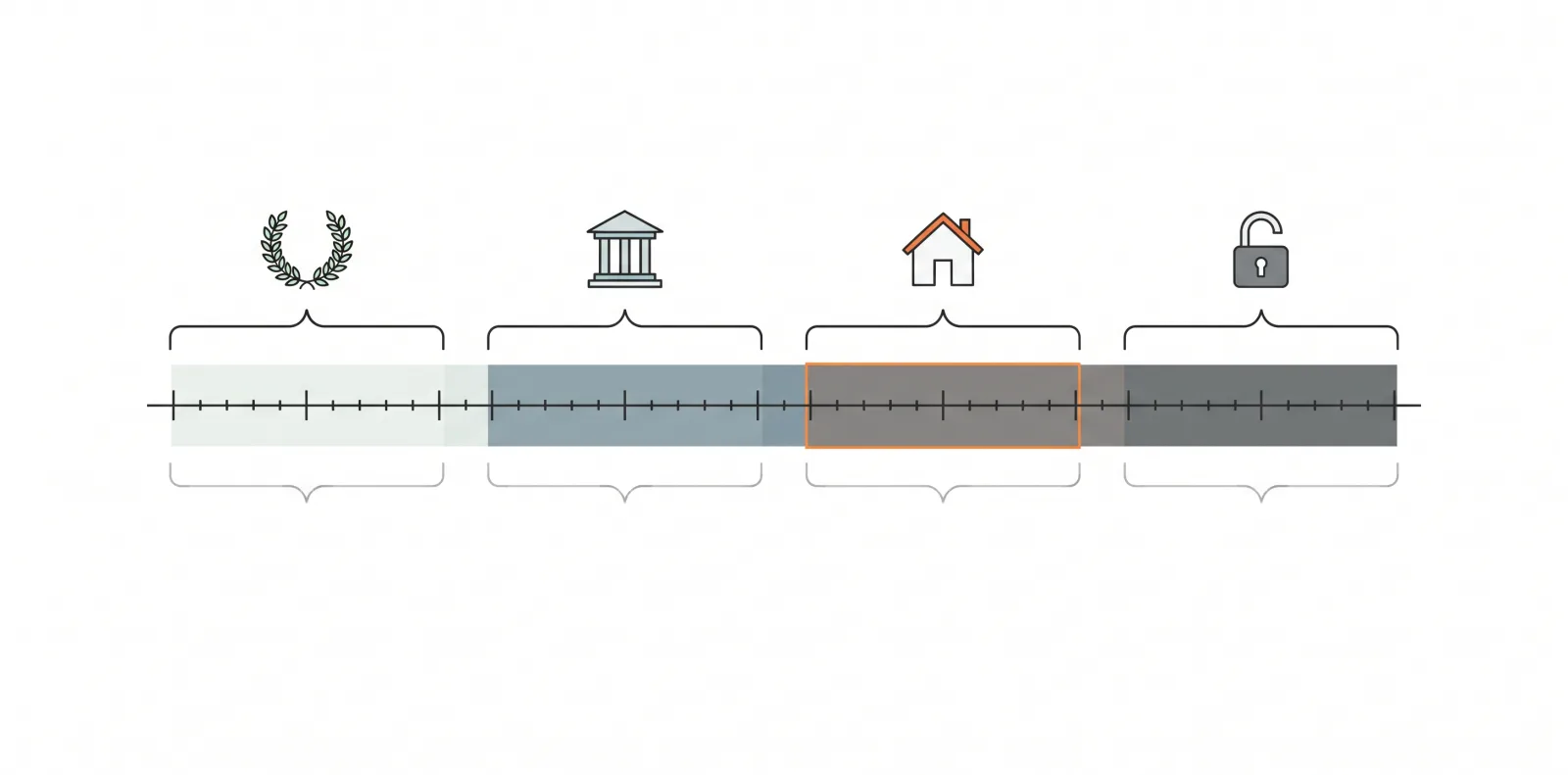
Reading the chart. The bands overlap, which means an individual quote depends on your specific profile rather than on the category alone. What the shape shows is the structural order: premier institution schemes cheapest, general public sector next, non-banking lenders above them, and unsecured non-banking lending at the top.
The concession worth asking about. Women borrowers can receive an interest rate concession of up to 0.5 per cent at several public sector banks including SBI, PNB, Bank of Baroda and Canara Bank. On a large loan over a long tenure this is a meaningful sum, and it is not always offered proactively. Ask.
Choosing Between A Bank And A Non-Banking Lender#
Choose a public sector bank if you qualify for a premier institution scheme, or you can offer collateral, or your borrowing need is within the collateral-free threshold. The rate advantage is substantial and it compounds over the tenure.
Choose a non-banking lender if you need more than the collateral-free threshold and have no property to pledge, or you need sanction quickly, or your institution or course falls outside what a public sector bank will fund readily.
What non-banking lenders genuinely offer. Speed, larger unsecured amounts, willingness to consider a wider range of institutions and courses, and a process that is generally less bureaucratic. These are real advantages and for some students they are decisive.
What they cost. Higher rates, processing fees commonly in the 1 to 1.5 per cent range, and frequently a requirement for a co-applicant with demonstrable income even where no property is pledged.
And apply to more than one. The Vidya Lakshmi portal allows a single application to reach multiple banks, and there is no obligation to accept a sanction. Comparing two or three actual offers is considerably more useful than comparing advertised rates.
What Floating Rates Mean Over A Decade#
Worth thinking through, because most borrowers do not.
Your rate will change. Public sector education loan rates are generally linked to the repo rate, so they move with monetary policy. A loan sanctioned at 9 per cent may be paying more or less than that in three years.
Your instalment or your tenure adjusts. When rates rise, lenders typically either increase the instalment or extend the tenure. The second option is less painful monthly and more expensive overall.
Model the downside. Compute your instalment at the quoted rate and again at two percentage points higher. If the higher figure is uncomfortable against a realistic starting salary, the loan is larger than your position supports.
Prepayment is usually your lever. Education loans generally permit prepayment without penalty, which means a borrower who receives a bonus or a salary increase can reduce the principal and shorten the tenure. This is the single most effective way to reduce total interest, and it is under-used.
And borrow to the need, not to the sanction. A sanctioned limit is a ceiling, not a target. Drawing only what each semester actually requires, rather than the full amount upfront, reduces the interest accruing during your course.
The Costs That Are Not The Interest Rate#
Two loans quoted at the same rate can cost meaningfully different amounts, because the rate is only part of the price.
Processing fee. Charged as a percentage of the sanction or as a flat amount. Public sector banks frequently waive it entirely for education loans; non-banking lenders rarely do. On a large sanction this is a real sum paid before you have received anything.
Loan protection insurance. Some lenders bundle cover that repays the outstanding balance if the borrower dies or is permanently disabled. It is often financed by adding it to the loan, which means you pay interest on the premium for the whole tenure. It is genuine protection, particularly where family property secures the loan, but it should be a decision rather than a default.
Legal and valuation charges. Applicable to secured loans, where the lender verifies title and values the property. Usually modest relative to the loan but payable regardless of whether the loan proceeds.
Prepayment terms. Education loans at floating rates generally carry no prepayment penalty, which matters because prepayment is the single most effective way to reduce total interest. Confirm this in the sanction letter rather than relying on the general rule, particularly with non-banking lenders.
Foreign exchange margin. For overseas loans disbursed in foreign currency, the spread the lender applies over the market rate is a recurring cost on every disbursement. A wide margin applied across eight semester payments adds up, and it is almost never quoted alongside the interest rate.
Late payment charges and documentation fees. Small individually, worth reading once so that nothing surprises you later.
How To Actually Run The Comparison#
Most families compare rates verbally across two branches and choose. That is not a comparison; it is an anecdote.
Get written sanction terms from at least two lenders, ideally one public sector bank and one other. Verbal quotes at a counter are indicative and move. A sanction letter states the rate, the spread, the fees, the margin requirement, the security demanded and the moratorium terms.
Compare on total cost, not headline rate. Add the processing fee, any insurance premium, and the effect of the margin requirement, then compute what you will repay over the full tenure at the quoted rate. A loan half a percentage point cheaper with a two percent processing fee is frequently worse than the alternative.
Check what the rate is benchmarked to. Floating education loan rates are typically an external benchmark plus a fixed spread. Two lenders quoting the same rate today may have different spreads over different benchmarks, which means they will diverge as policy rates move. The spread is the part that is fixed for you; the benchmark is not.
Ask what concessions apply and get them in writing. Women borrowers, premier institution lists, and interest servicing during the moratorium all attract reductions at various lenders. None are applied automatically to every eligible borrower.
Ask about the margin. The proportion of the cost you must fund yourself varies between lenders and between domestic and overseas loans. A lower margin requirement is worth real money at the start, when cash is tightest.
Then negotiate. A written sanction from one lender is leverage at another, and education loan pricing has more room in it than most applicants assume.
Frequently Asked Questions#
What is the range of education loan rates in 2026?#
Roughly 6.9 per cent to around 14 per cent. The lowest rates apply to premier institution schemes at public sector banks and the highest to unsecured lending from non-banking finance companies.
How much can I borrow without collateral?#
Most public sector banks lend up to around ₹7.5 lakh without security. Non-banking lenders will lend substantially larger unsecured amounts, reported up to the ₹40 lakh to ₹75 lakh region depending on lender and profile, at higher rates.
What is the premier institution rate?#
SBI's Scholar Loan for admits to listed premier institutions starts in the region of 6.90 per cent, against roughly 9.40 to 9.90 per cent for its general student loan scheme. Check whether your institution appears on the relevant list.
Do women get a lower rate?#
Several public sector banks including SBI, PNB, Bank of Baroda and Canara Bank offer a concession of up to 0.5 per cent to women borrowers. It is not always offered proactively, so ask explicitly.
Are education loan rates fixed or floating?#
Most public sector bank products carry floating rates linked to the repo rate, so they move over the tenure. Several non-banking lenders offer fixed rates at a higher starting level, trading cost for certainty.
What is a processing fee?#
A one-off charge on sanction. Public sector banks frequently waive or minimise it, while non-banking lenders commonly charge around 1 to 1.5 per cent, which on a large loan is a significant amount.
Should I take the full sanctioned amount?#
No. A sanction is a ceiling rather than a target. Drawing only what each semester requires reduces the interest accruing during your course, and you retain access to the remainder if needed.
Where should I verify current rates?#
Directly with the lenders, since rates change with monetary policy and advertised figures go stale. The Vidya Lakshmi portal lets you apply to several banks from one form, which produces actual offers to compare rather than advertised ranges.